
Nvidia reports Wednesday, and the entire market is going to trade a number that tells you almost nothing. Revenue will land somewhere near $93 billion, everyone will call it a beat or a miss, and the stock will move 5% on it. Meanwhile the figure that actually determines whether this trade survives the next two years is buried in a footnote of the 10-Q, and almost nobody will read it.
That figure is Nvidia customer concentration. And it has gone somewhere genuinely strange.
Nvidia doesn’t have a market. It has four customers.
In the most recently disclosed breakdown, four direct customers each accounted for more than 10% of Nvidia’s total revenue: 22%, 15%, 13% and 11%. Together — 61% of the company. A year earlier, the same disclosure showed two customers at 20% and 16%: about 36%.
So in roughly twelve months, Nvidia went from “two large customers” to “four customers who are, collectively, most of the business.” Revenue grew 65% to $216 billion over that stretch. Concentration grew faster than revenue did.
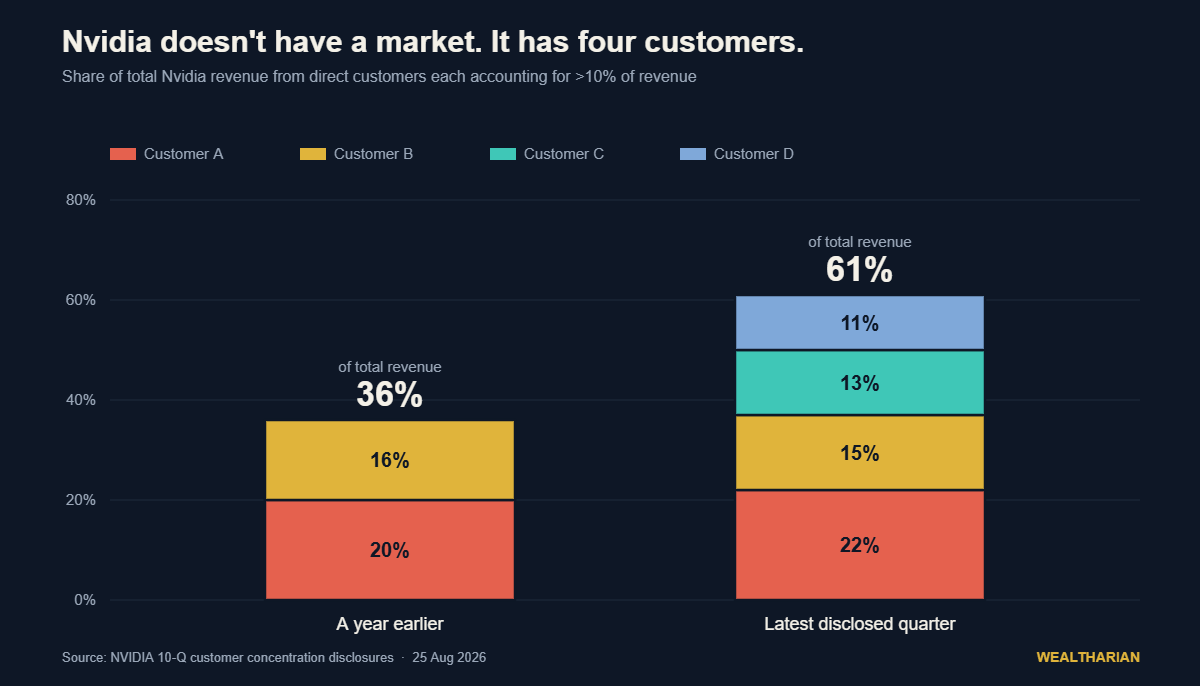
This is the part people get wrong. Rising concentration during a boom is normally read as a bullish signal — it means the biggest, best-capitalised buyers are leaning in hardest. And that reading is fine, right up until the moment those buyers stop paying for their purchases out of earnings and start paying for them out of the bond market.
Which is exactly what happened.
Nvidia’s revenue is now a credit product
Amazon, Alphabet and Microsoft are on track to spend roughly 102% of their cloud revenue on capex in 2026. Read that again. Not 102% of profit — 102% of the entire revenue line that the spending is supposed to serve. The Big Five hyperscalers are looking at something like $775–800 billion of AI infrastructure spend this year, and UBS puts the 2026–2028 total at $4.1 trillion.
Cash flow does not cover that. So the gap gets financed.
Hyperscalers and the wider AI infrastructure ecosystem have issued about $244 billion of bonds through July 2026 — more than double the $108 billion issued in all of 2025. Meta alone did a single $30 billion corporate bond sale and disclosed roughly $279 billion of off-balance-sheet data centre lease obligations. Someone issued a century bond. Full-year 2026 estimates for AI-related issuance run from $300 billion to $570 billion.
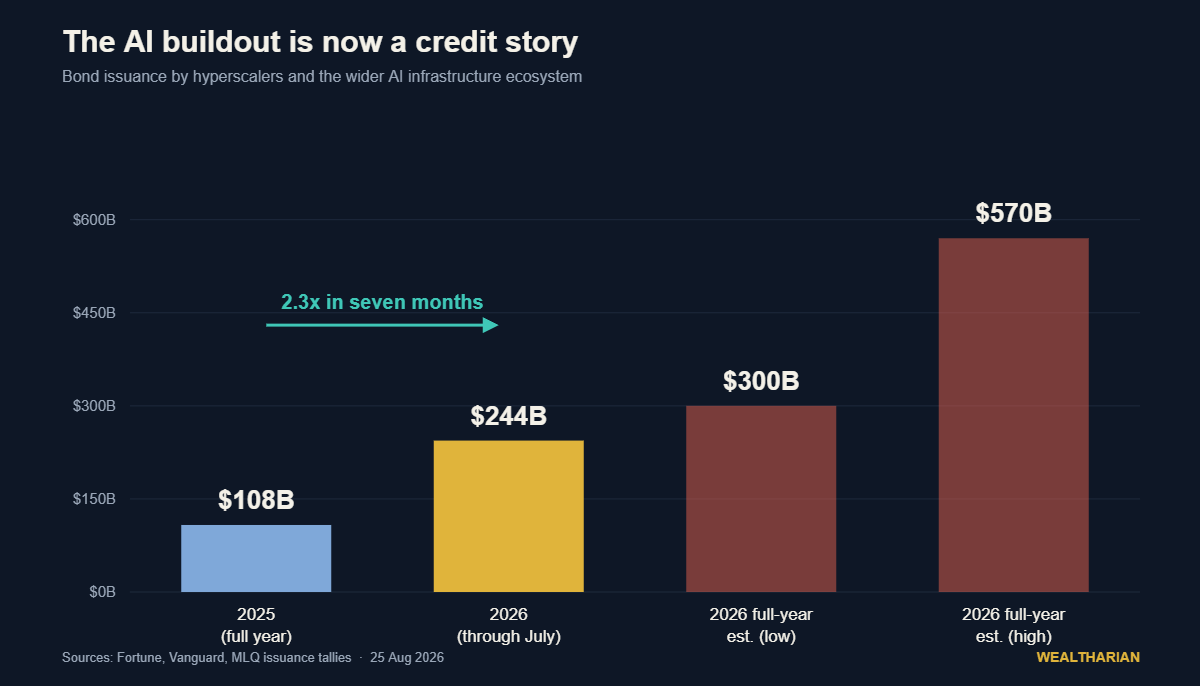
Put the two facts side by side and the picture reorganises itself:
61% of Nvidia’s revenue comes from four companies who are funding a material share of their purchases with debt.
Nvidia is not a semiconductor company with a large addressable market. Right now it is a highly levered bet on four balance sheets and the credit market’s continued willingness to fund them. That is not a demand risk. It is a counterparty risk, and it behaves completely differently.
Why the distinction actually matters
A demand risk unwinds slowly. Orders soften, backlog thins, guidance walks down over three or four quarters, and you get plenty of time to react. Everyone watching for “signs of AI demand cooling” is watching for a slow-motion event.
A funding risk does not unwind slowly. Credit conditions gap. Spreads widen, a deal gets pulled, and a capex plan that looked committed becomes a capex plan that gets “re-phased” — the most expensive word in corporate finance — inside a single quarter. And because the buyers are concentrated, one of them re-phasing is not a 3% revenue event for Nvidia. It’s a 10–22% revenue event.
There’s already evidence that the bond market is getting tired. Reporting through the summer pointed to softening investor demand for AI paper even as issuance accelerated. That is the combination that matters: supply up, appetite down. It doesn’t show up in Nvidia’s revenue line. It shows up in Nvidia’s customers’ funding costs, six to nine months before it shows up in Nvidia’s orders.
What to actually read on Wednesday
Skip the headline. Three things carry real information:
1. The customer concentration footnote. Did the top four go above 61%? If yes, the business got more fragile while it got bigger. If a fifth customer crosses 10%, that is genuinely bullish — it means the buyer base is broadening, which is the single best thing that could happen to this stock.
2. Days sales outstanding. DSO was 45 days last quarter, down from 51, helped by early customer payments. Management flagged it would normalise. If DSO climbs meaningfully past 51, your concentrated, debt-funded customers are paying more slowly — and slow payment is what funding stress looks like before anyone says the word out loud.
3. Supply commitments versus inventory. Inventory rose to $25.8 billion from $21.4 billion, with $119 billion of total supply-related commitments. Nvidia has pre-committed enormous capital on the assumption that four customers keep buying. If inventory keeps outrunning revenue growth, the company is building for demand that hasn’t been contracted yet.
The wealth angle: you already own this
Here’s the part that makes this everyone’s problem rather than a trader’s problem. As we covered in our look at record index fund concentration, a single company is now around 7.5% of your S&P 500 fund. If you hold a total-market index fund and think you’re diversified, you are holding a position whose earnings depend on four other companies’ access to the bond market.
Your “diversification” has a single counterparty chain running through it. Diversification across tickers is not diversification across risks.
The response to this is not to panic-sell your index fund. It’s to be honest about what you own. If Nvidia, its four customers and its suppliers together represent a quarter of your equity exposure — and for most passive investors they now do — then adding more US large-cap growth isn’t diversifying. Adding duration you actually get paid for, international equity, or cash at a real yield is.
And note what this argument is not. It isn’t “AI is a bubble.” AI demand looks real; the collapsing cost of intelligence is creating genuine economic value, and the productivity gains are showing up. The risk isn’t that nobody wants the compute. The risk is how the compute is being paid for, and how few entities are doing the paying.
Booms rarely die of insufficient demand. They die of financing.
On Wednesday, everyone will be reading the revenue line. Read the footnote.
Want to track your own path to financial independence? The Wealtharian Wealth Tracker lets you monitor your net worth, FU money progress, and investment milestones in one place. Try it free →