
Everyone is arguing about whether AI demand justifies the spending. That argument is a decoy. The number that decides whether the AI trade survives 2027 is not revenue. It is one sentence buried in the notes to the financial statements, and almost nobody is trading on it.
Here is the setup. The five largest hyperscalers — Microsoft, Amazon, Alphabet, Meta and Oracle — are guiding to somewhere between $660 billion and $800 billion of capital expenditure in 2026, depending on whose estimate you use. That is roughly three times the $238 billion they deployed in 2024. Meanwhile the two biggest pure-play AI labs run a combined annualised revenue of about $75 billion: Anthropic’s run rate reportedly passed $65 billion ahead of a planned IPO, and OpenAI has been sitting near $24–25 billion.
The bear case writes itself. Seventy-five billion of revenue against seven hundred billion of spending is roughly 11% coverage, therefore bubble. It is clean, satisfying, and repeated everywhere. It is also the wrong argument.
The revenue-coverage argument is lazy
OpenAI and Anthropic were never supposed to fund the entire buildout by themselves. Hyperscalers do not sell compute only to frontier labs — they sell it to every bank running fraud models, every retailer running demand forecasting, every software company that quietly bolted inference onto its product last year. Comparing two labs’ revenue to the entire industry’s capital spending is like comparing Netflix’s subscription revenue to the total construction cost of the world’s fibre networks and concluding that broadband was a hoax.
And demand, as it happens, is not the soft spot. Broadcom guided third-quarter AI semiconductor revenue to roughly $16 billion, up more than 200% year on year. Nvidia reports on 26 August, Marvell on 27 August. Order books are not where the crack is.
AI capex depreciation is where the earnings actually live
Here is the part that matters. When a company spends $50 billion on chips, the cash leaves immediately — but it hits reported profit slowly, spread across the asset’s assumed useful life. Change that assumption and you change reported earnings by tens of billions without a single dollar of business changing hands.
Between 2022 and 2024, Microsoft, Alphabet, Meta and Oracle each extended the assumed useful life of server and network equipment. Microsoft went from four years to six, effective fiscal 2023. Alphabet moved servers from four to six the same year. Meta stretched certain servers to 5.5 years from January 2025. Amazon is the outlier that went the other way, cutting from six years back to five in early 2025.
Those decisions were made about fleets that were overwhelmingly CPU-based. They are now being applied to GPU fleets running at near-continuous utilisation, in a market where a two-generation-old accelerator is not so much broken as economically embarrassing. The working assumption among people who actually operate this hardware is that a frontier GPU has a useful economic life closer to two or three years than six.
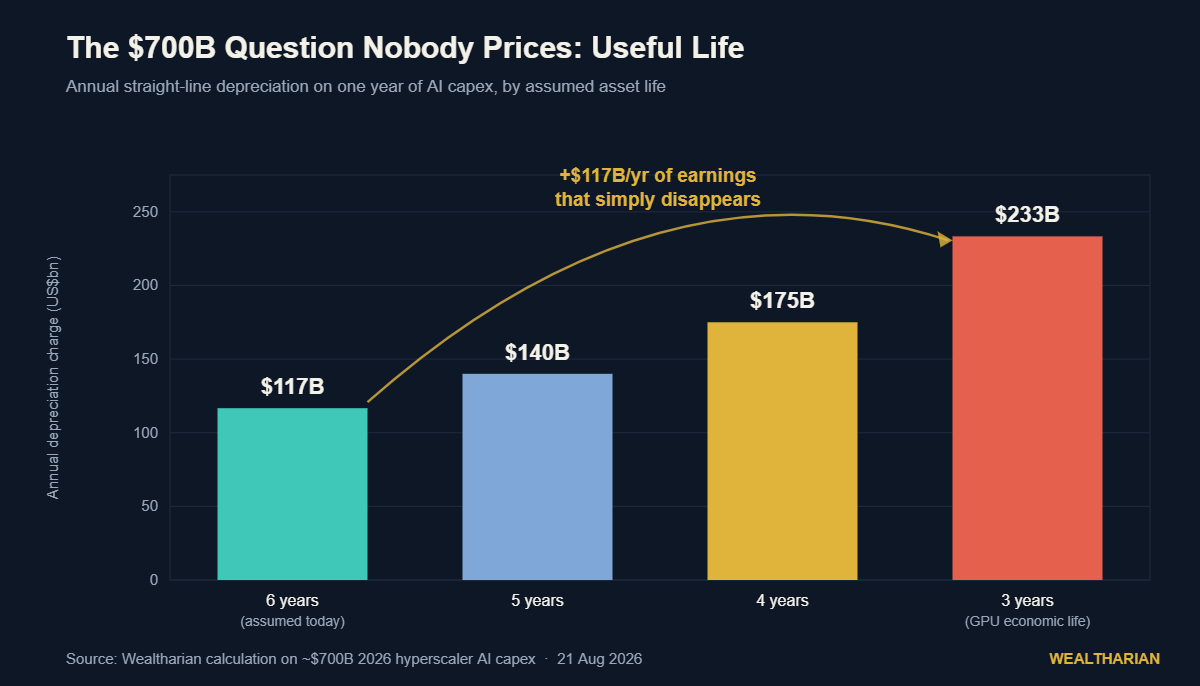
Run the arithmetic on a single year of capex. Depreciate $700 billion straight-line over six years and you book about $117 billion of annual expense. Over three years, you book $233 billion. That $117 billion gap is not a rounding error — it is roughly the combined annual net income of two of the five hyperscalers, appearing or disappearing purely as a function of an accounting estimate. One analysis puts the cumulative understatement of true asset depletion at around $176 billion between 2026 and 2028.
Nobody has to be lying for this to hurt. Auditors sign off on ranges, and six years sat comfortably inside the range when the fleet was CPUs. The danger is not fraud. It is a slow, legitimate, unavoidable convergence of accounting life toward economic life — and every step of that convergence comes straight out of reported EPS.
The cash cushion runs out at the same time
This would be manageable if the buildout were still being funded out of pocket change. It is not.
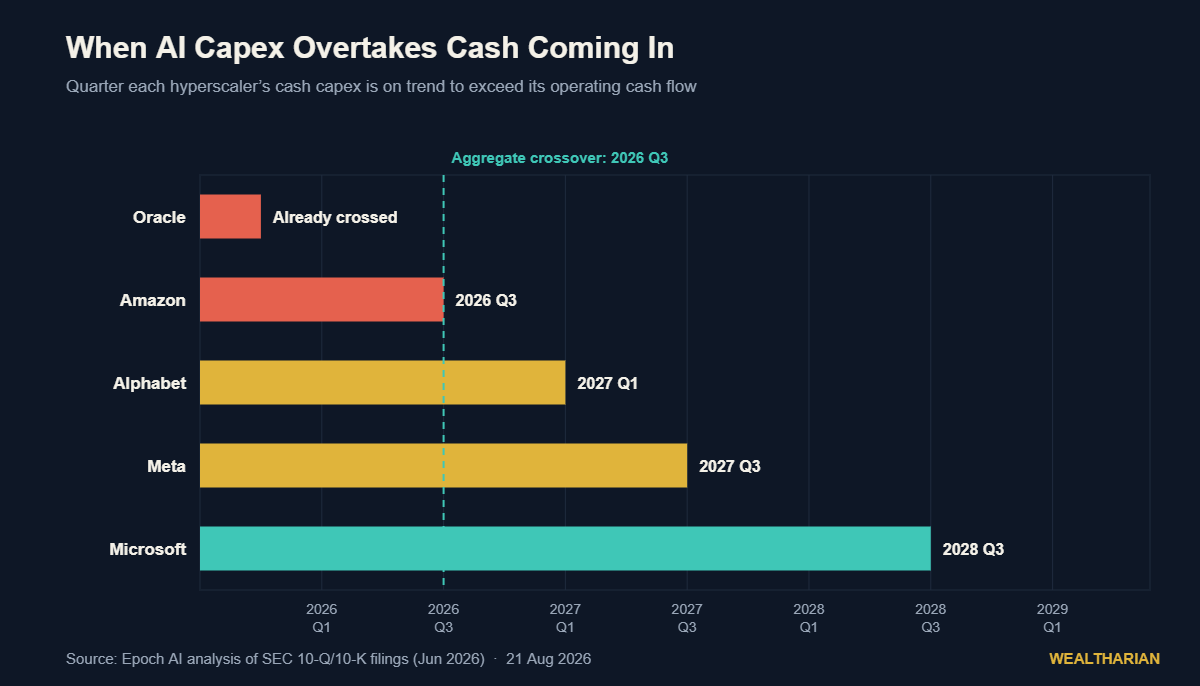
Epoch AI, parsing the XBRL tags in SEC filings directly, finds aggregate cash capex across the big five growing about 70% a year while operating cash flow grows about 23%. Those lines cross around the third quarter of 2026 — which is to say, now. Oracle has already crossed. Amazon is crossing. Alphabet is projected for early 2027, Meta for late 2027, Microsoft not until 2028.
The evidence is already in the cash flow statements. Amazon’s trailing-twelve-month free cash flow has fallen from roughly $26 billion a year ago to around $1.2 billion. Microsoft’s is down about 22%, Alphabet’s about 38%. The funding mix has shifted accordingly: incremental annual debt has gone from around 9% of capex in fiscal 2024 to roughly 32% on a trailing basis by mid-2026, and Alphabet went to the equity market for $80 billion. On top of that sits an estimated $662 billion of data centre leases that have been signed but not yet commenced — obligations that are entirely real and, under the lease commencement standard, entirely off balance sheet.
We argued a few weeks ago that the AI trade had quietly become a credit trade. The depreciation question is the other half of the same story: the credit market decides whether the buildout can keep being financed, and the useful-life assumption decides what the earnings look like while it is.
What this actually means for your money
This is not a “sell AI” argument, and anyone who reads it that way has skipped the interesting part. The technology is real, the productivity gains are showing up in wages, and the buildout is producing genuine capacity that the economy will use for a decade. We have written before about how the biggest AI money is showing up in labour income, not portfolios. That has not changed.
What changes is what you should be watching, and what you should refuse to pay up for. Five things belong on the list:
- The useful-life sentence in the 10-Q. It sits in the significant accounting estimates note. Any move from six years toward four is a mechanical hit to EPS with no change in the business. Read it before the market does.
- Free cash flow, not adjusted EBITDA. Depreciation assumptions cannot flatter cash. If a company’s earnings are growing while its free cash flow collapses, the gap is the accounting.
- Incremental debt as a share of capex. Nine percent to thirty-two percent in under two years is a regime change, not a data point.
- Signed-but-not-commenced lease commitments. Roughly $662 billion of them. They are disclosed, and they are almost never in anybody’s model.
- Compute as a share of total capex. Around 60% in 2026 versus roughly 43% in 2022. The higher that share goes, the more the whole earnings profile depends on one estimate about how long a GPU stays useful.
The practical implication is preference, not exit. Between two companies with identical AI exposure, prefer the one funding it out of operating cash flow over the one funding it with bonds, and prefer the one with the conservative depreciation schedule over the one with the flattering one. In a cycle where capital is no longer free — and a 3% real yield on 30-year TIPS says it is not — that preference is worth a great deal more than it was in 2021.
The Wealtharian take
Bubbles rarely end because the story turns out to be false. They end because the accounting catches up with the story. Railways were transformative and a bubble. Fibre was transformative and a bubble. In both cases the assets got built, the economy got the benefit, and the equity holders who paid for optimism at the top got wiped out by the depreciation of assets that turned out to have shorter lives than the spreadsheets assumed.
AI capex depreciation is that same fault line, and it is unusually knowable in advance. It is disclosed quarterly, in plain English, in documents anyone can read for free. The market is spending its attention on Nvidia’s next guide. The move that matters will be announced in a footnote, on a Thursday, in a paragraph nobody reads.
Read the footnote.
Want to track your own path to financial independence? The Wealtharian Wealth Tracker lets you monitor your net worth, FU money progress, and investment milestones in one place. Try it free →