
The 30-year TIPS real yield just hit 3% for the first time since 2008. Every headline this week framed it as a crisis. It is closer to the opposite: the first time in eighteen years that an ordinary saver can buy a guaranteed, inflation-proof return without touching the stock market.
What actually happened this week
On 18 August the 30-year Treasury yield touched 5.327% intraday, its highest level since 2007 and now within striking distance of the 5.44% pre-crisis peak. The reporting was uniformly grim: a bond selloff, a ballooning deficit, a flood of long-dated issuance, and inflation that has now spent five straight years above the Fed’s 2% target. July CPI came in at 3.4% headline and 2.5% core. Futures put the odds of a September rate cut at just 32.6%.
Meanwhile the S&P 500 closed at a record 7,798.99 earlier in the month. Mortgage rates sat near 6.67%. And $7.93 trillion is parked in money market funds, down only slightly from May’s record $8.281 trillion.
Those four facts are usually reported as four separate stories. They are one story, and almost nobody is telling it properly.
The number that matters is not 5.33%. It is 3%.
Nominal yields are noise. A 5.33% coupon means nothing until you know what inflation does to it over thirty years. The number that actually matters is the real yield — what Treasury Inflation-Protected Securities pay you above whatever inflation turns out to be.
That number is now roughly 3.0%. It has been sitting there for weeks. The last time it was there, Lehman Brothers was still in business.
For context: in 2021 the 30-year TIPS real yield was approximately zero, and at points slightly negative. The government was offering to preserve your purchasing power and charge you a small fee for the service. That was the entire intellectual foundation of “there is no alternative” — the argument that you had to own equities at any valuation because the alternative was guaranteed slow erosion.
That argument is now dead, and the people who built portfolios around it have mostly not noticed.
What a 3% real yield is actually worth
Here is the part that never makes the headlines. Run the standard annuity math on a thirty-year horizon — PMT = r / (1 − (1+r)−30) — and a real yield of 3% lets a $1,000,000 portfolio throw off $51,019 a year, inflation-adjusted, for thirty years, with essentially no market risk. At a 0% real yield, the same million buys $33,333.
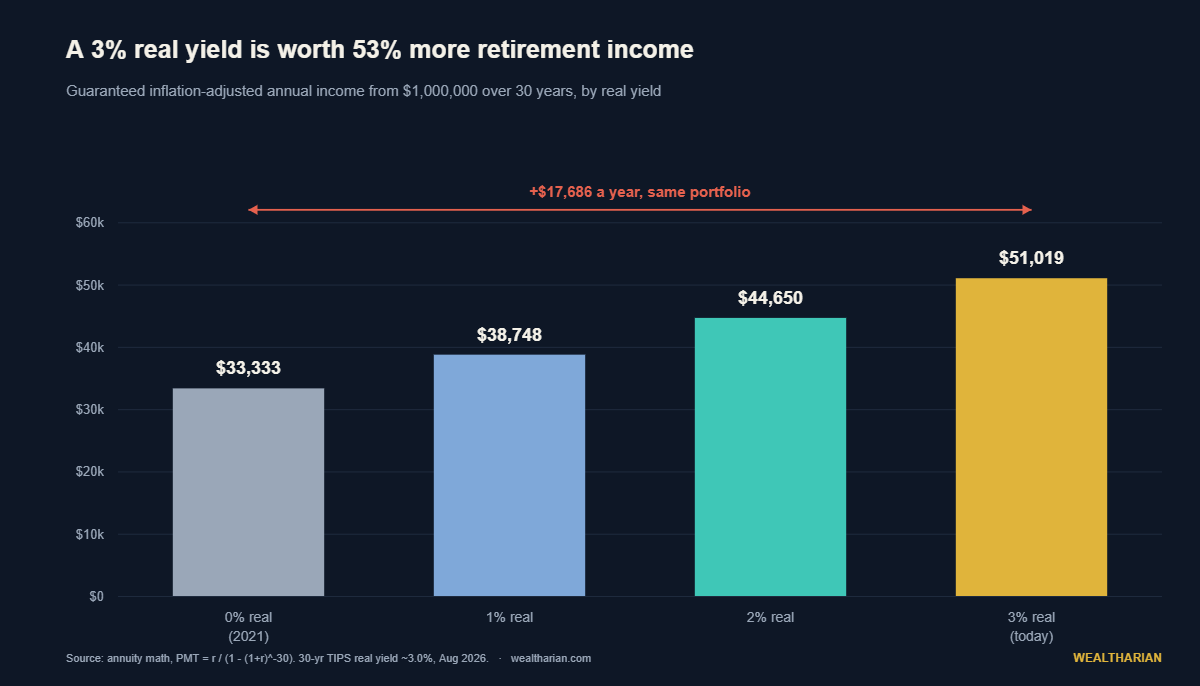
That is a 53% increase in lifetime spending power from the same pile of money, delivered entirely by a change in the price of safety. No stock picking. No leverage. No AI thesis. In practice a real TIPS ladder nets slightly less than the clean formula — the shorter rungs yield less than the thirtieth — so the honest number today is around 4.9% rather than 5.1%. It is still the best guaranteed withdrawal rate available in roughly two decades.
Set that against the reality of American retirement balances. Vanguard’s average 401(k) is $167,970 and the median is $44,115. Median retirement savings across all families is $87,000. For anyone in that range, an extra 1.7 percentage points of guaranteed real return is not a rounding error. It is the difference between a plan and a hope.
The contrarian part: a negative risk premium is not a sell signal
Here is where most of the commentary goes wrong.
The S&P 500’s earnings yield is about 4.73%. The 10-year Treasury yields 4.56%. The 30-year yields 5.33%. Subtract, and the equity risk premium — the extra compensation you receive for accepting the risk of owning businesses instead of lending to the government — is roughly +0.17 points against the 10-year and negative 0.60 points against the 30-year. Measures using forward earnings put it closer to −1.2% and −1.5%. The long-run average is around +2.2 points.
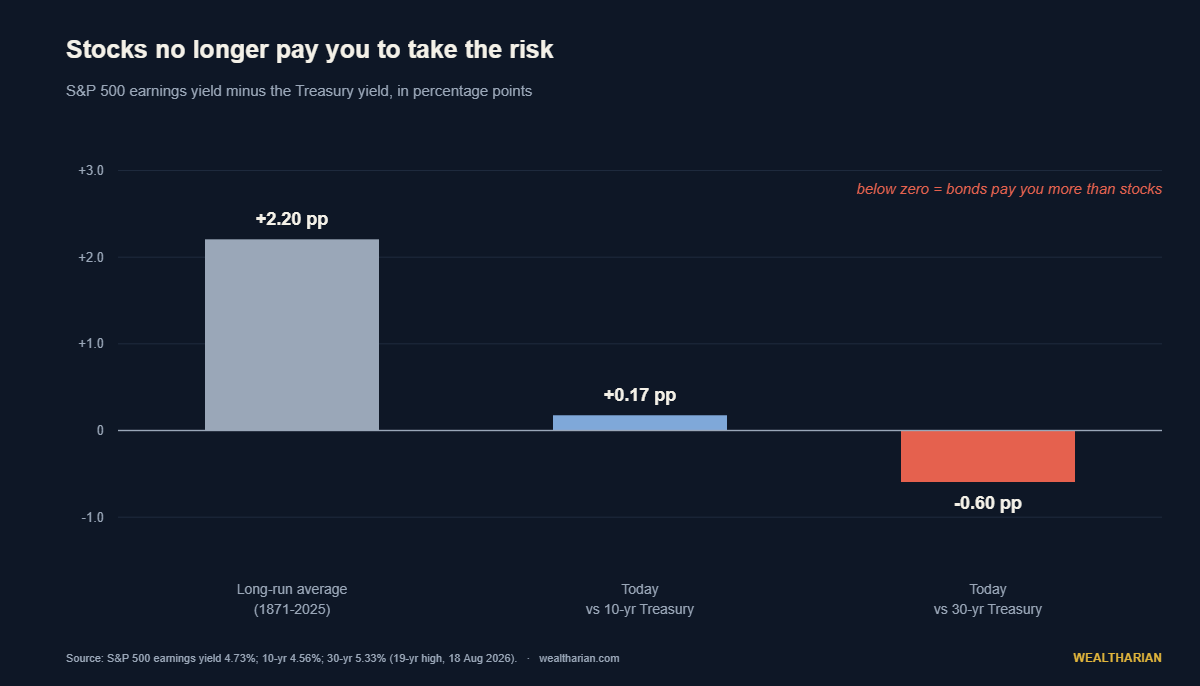
The obvious conclusion is “sell stocks.” The obvious conclusion is wrong, and the historical record is unusually blunt about it. The equity risk premium was negative for nearly the entire span of the 1980s and 1990s. That period contained the greatest bull market in American history. A negative ERP has essentially no power to tell you what equities will do next year, or the next five.
What it does tell you is something more useful and much less exciting: the market is no longer paying you to take risk you do not need to take. That is a portfolio-construction signal, not a market-timing signal. The right response is not to guess the top. It is to ask which of your risks are still being compensated — a question we worked through when the AI trade quietly became a credit trade.
Three things this actually changes
1. Your safe assets have a job again. For fifteen years, “bonds” in a 60/40 portfolio were a drag you tolerated for the diversification. At 3% real, the defensive sleeve is now a genuine engine. If you are within a decade of needing the money, locking a portion of that real yield removes a category of risk from your life permanently.
2. Cash is now the expensive choice. The $7.93 trillion sitting in money market funds is earning a short-term rate that resets the moment the Fed moves. The 30-year real yield is a rate you can lock for thirty years. Investors have spent two years congratulating themselves for holding cash while declining to secure the one thing cash cannot give them: duration. That is reinvestment risk, and it is the quiet cost of feeling safe.
3. Every borrowing decision just got more expensive to get wrong. A 6.67% mortgage and a 3% risk-free real return are the same fact viewed from two ends. Paying down debt at 6%+ is now competing directly against a guaranteed 3% real, and in most cases winning. The arithmetic of household balance sheets has genuinely shifted, which is part of what makes the credit-card delinquency data so widely misread.
The honest counterpoint
Two things could make this look foolish in hindsight. Real yields could keep climbing — if the deficit worry that drove this selloff intensifies, 3% could become 3.5%, and anyone who locked in today would have left money on the table. And equities could do what they did through the 1980s and 1990s and simply run, negative risk premium and all.
Both are real. Neither is an argument for doing nothing. The point is not that bonds will beat stocks. The point is that a decision which was genuinely unavailable for eighteen years is available now, and the window for these things has historically been measured in quarters rather than decades.
The market is at a record while consumer confidence sits near lows — a gap we argued is not actually a contradiction. This is the same phenomenon in a different register. The headlines are describing a bond market crisis. The spreadsheet is describing the cheapest financial independence has been to buy since 2008.
Read the spreadsheet.
Want to track your own path to financial independence? The Wealtharian Wealth Tracker lets you monitor your net worth, FU money progress, and investment milestones in one place. Try it free →