
Ten companies are now 39.5% of the S&P 500 — the highest concentration ever recorded. One of them reports earnings on Wednesday, and the options market is pricing an 8–12% move.
Index fund concentration has stopped being a statistic for market historians and started being a line item in your retirement account. If you own a plain S&P 500 fund, 7.55% of it is Nvidia. Not 7.55% of your tech sleeve. 7.55% of the whole thing. Apple is another 7.05%. You did not choose either position, you cannot see it on your quarterly statement, and it is almost certainly the largest single-stock bet you have ever made.
The usual response to this is a warning that the market is fragile. That is unfalsifiable and useless — it gives you nothing to do on a Monday morning. The useful version of the story is one level down, and it is entirely fixable.
What record index fund concentration actually looks like
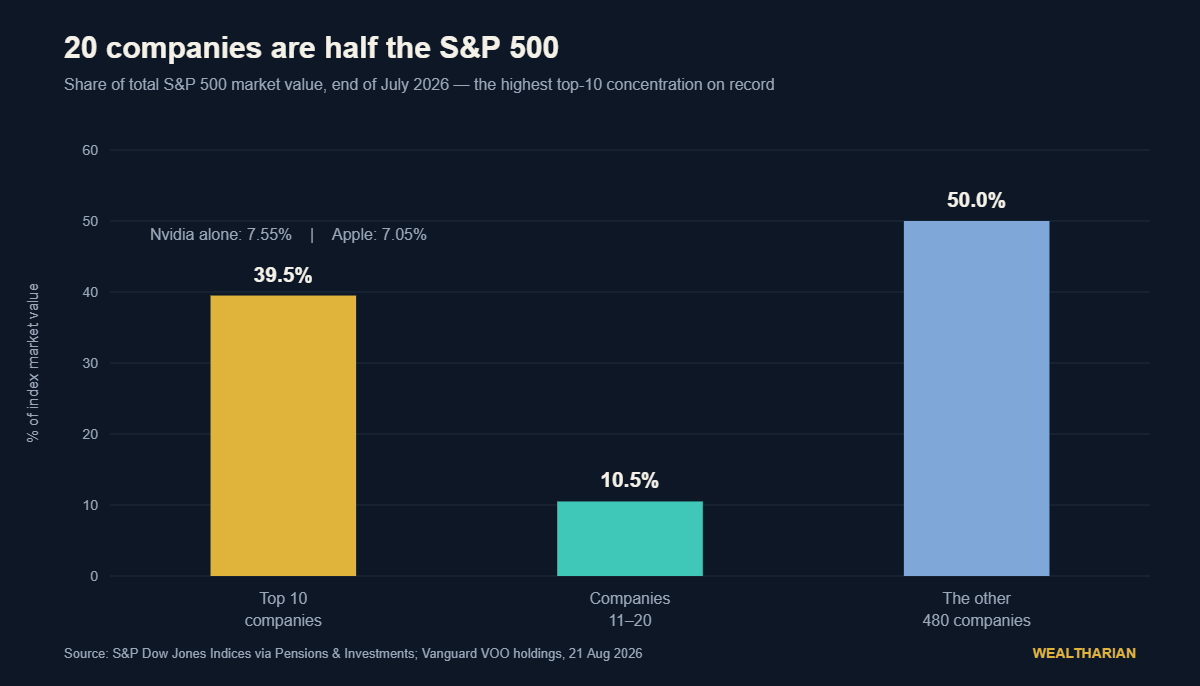
At the end of July 2026, the ten largest companies in the S&P 500 controlled 39.5% of the index’s total market value — the highest share in the data. Twenty companies now make up half the index. The other 480 make up the other half.
Nvidia’s 7.55% weight in Vanguard’s VOO overtook Apple’s 7.05% this month, making it the largest constituent in the index for the first time. Put a million dollars into an S&P 500 fund and roughly $395,000 of it lands in ten businesses, of which about $75,000 lands in one.
This is happening at a price. The index trades at 3.23 times sales — the highest multiple ever recorded — and a forward P/E of 22.5 against an average of 16.8 since 2000. The S&P set an all-time high of 7,814.88 this month. Concentration and valuation are not independent risks here. They are the same risk wearing two name tags.
Wednesday is a portfolio event, not a tech story
Nvidia reports on Wednesday, 26 August. Consensus sits at $93–95 billion in revenue, roughly 96% year-over-year growth, and the options market is pricing an 8–12% single-session move.
Run the arithmetic on your own account rather than on the headline. A 10% move in a 7.55% position moves the entire index by about three quarters of a percent, overnight, from one company’s guidance call. If your S&P fund holds $400,000, that is roughly $3,000 decided by one CFO’s commentary on one Wednesday evening — before anyone has said a word about the other 499 companies you own.
Then the new Fed chair speaks. Jackson Hole runs 27–29 August, Kevin Warsh’s first as chair, with the funds rate parked at 3.50–3.75% for a fifth straight meeting on a 9–3 vote and July CPI still at 3.4%. Warsh has already stripped forward guidance out of the FOMC statement. Two of the largest inputs to your portfolio’s next month get resolved inside 72 hours, and neither of them is under your control.
The mistake isn’t owning it. It’s owning it four times.
Here is the part almost nobody measures. Diversification is reported at the fund level and experienced at the portfolio level, and those two numbers have quietly stopped matching.
A typical “diversified” setup looks like an S&P 500 fund, a total-market fund, a Nasdaq or technology fund, a target-date fund in the 401(k), and an international fund for balance. Five products. Five different tickers. Five prospectuses that each describe a well-diversified portfolio.
They resolve to the same ten companies. The total-market fund is the S&P plus a rounding error of small caps. The target-date fund is a fund of funds built largely from the same index sleeves. And the international allocation is the one that surprises people: the United States is roughly 66% of the MSCI ACWI, and the Magnificent Seven alone are just under a quarter of the MSCI World index. Your hedge against America owns America.
Stack those five products and a household that believes it holds 3,000 companies can easily have 45–50% of its equity in ten of them. That is not a market problem. That is an accounting problem, and you can fix accounting problems in an afternoon.
The popular fix is a different bet, not a hedge
The reflex answer is equal weight: same 500 companies, 0.2% each, no mega-cap distortion. It is a reasonable position. It is not insurance, and it is not free.
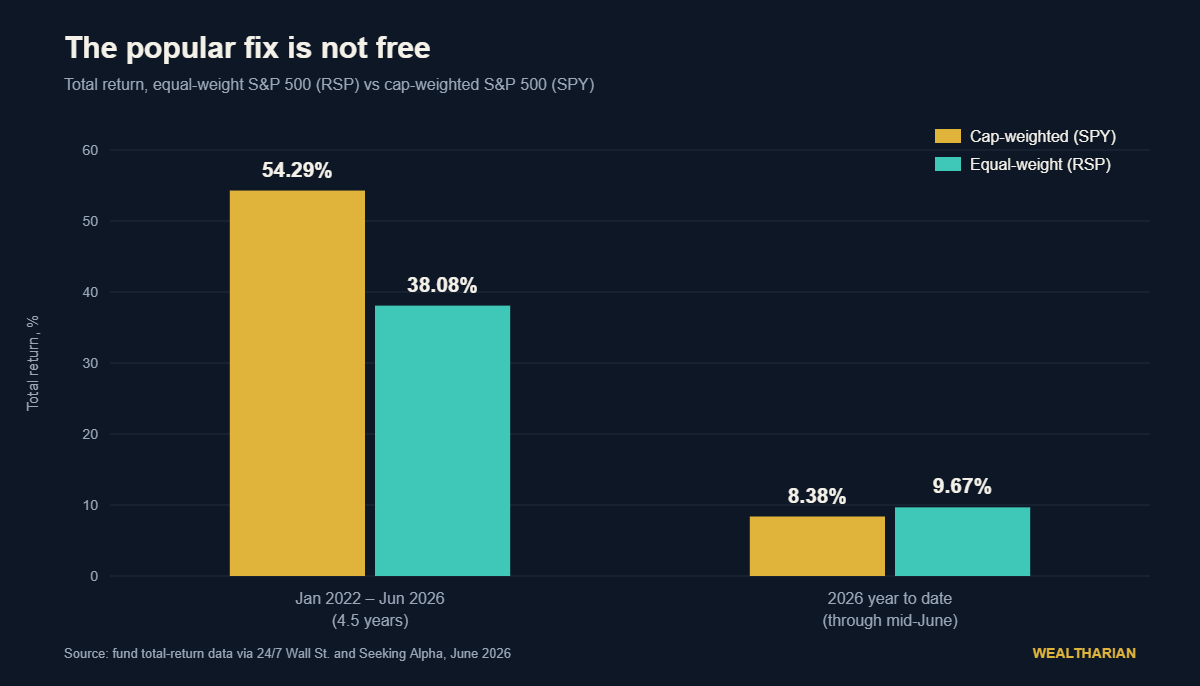
From January 2022 through June 2026, the cap-weighted S&P returned 54.29% while the equal-weight version returned 38.08%. Sixteen percentage points, surrendered over four and a half years, by an investor who was right about concentration risk the entire time and simply early.
2026 flipped it: equal weight is up 9.67% year to date against 8.38% for cap weight, a lead of roughly two points by early July. That is what a broad-breadth year looks like. Equal weight is a bet that leadership widens. Sometimes it does. Treating a directional bet as a safety measure is how people end up with both the underperformance and the risk.
What to do with this instead
Measure your look-through exposure. Pull the top ten holdings of every equity fund you own, weight them by what you actually hold, and add up the duplicates. One spreadsheet, thirty minutes. Most people find a number they would never have chosen deliberately.
Then set a policy limit, not a forecast. Something like: no single company exceeds 6% of my liquid net worth. A limit is checkable and unemotional. A forecast is a mood. If you are under the limit, you do nothing on Wednesday — which is the entire point of having one.
Diversify by risk factor, not by fund label. Owning five products that all price off the same handful of earnings streams is not diversification. Genuinely different exposures behave differently: long real yields, for one — the 30-year TIPS real yield touching 3% is a bigger structural event than another index record. And be honest about the cash leg, because the average American savings account pays 0.02%, which is not a safe asset so much as a slow one.
Separate the concentration from the thesis. Concluding your index is too concentrated in AI infrastructure is not the same as concluding AI infrastructure is overvalued. Those are two different arguments and they need two different pieces of evidence — the real risk in the AI trade is depreciation schedules, not demand. You can be entirely bullish on the technology and still decide you would rather not have three quarters of a percent of your net worth hinge on one earnings call.
The record isn’t a prediction
Concentration at 39.5% does not tell you the market falls. It tells you something narrower and more actionable: the range of outcomes in your portfolio is now set by fewer decisions, made by fewer people, disclosed on fewer dates. That is a structural fact you can measure this week, regardless of what the market does next.
Wednesday will produce a number. Whether it produces a problem for you depends entirely on work you can do before it lands.
This is general information about portfolio construction, not personalised investment advice.
Want to track your own path to financial independence? The Wealtharian Wealth Tracker lets you monitor your net worth, FU money progress, and investment milestones in one place. Try it free →