
Nvidia reported $96.2 billion in revenue on Wednesday — a $4 billion beat, up 106% from a year ago — and guided to $108 billion for the current quarter. Wall Street read it as proof the AI trade is intact. That reading is right about the demand and wrong about where the money is actually going.
Here is the number nobody put on a chyron. Memory now consumes roughly 30% of every dollar hyperscalers spend on AI data centers, up from about 7.5% in 2023. Analysts expect that to reach 36% next year. The AI memory shortage has quietly become the binding constraint on the entire buildout — and unlike the GPU shortage, this one is going to show up on your personal receipts.
The quarter everyone celebrated
The headline figures were genuinely excellent, and it would be dishonest to pretend otherwise:
- Revenue of $96.2 billion, up 106% year over year and 18% sequentially, against a $92.07 billion consensus.
- Data center revenue of $89.0 billion, up 117% year over year, against roughly $86.3 billion expected.
- Non-GAAP earnings of $2.22 per share versus $2.09 expected.
- Guidance of $108 billion for the current quarter, roughly $4 billion above the Street.
- Jensen Huang publicly forecasting ~70% revenue growth for fiscal 2028.
None of that is bearish. We wrote before the print that the number that mattered was never revenue, and the quarter proved the point in a way we did not expect. The interesting information was not in Nvidia’s income statement. It was in what its customers are being forced to spend everywhere else.
The AI memory shortage is the real bottleneck
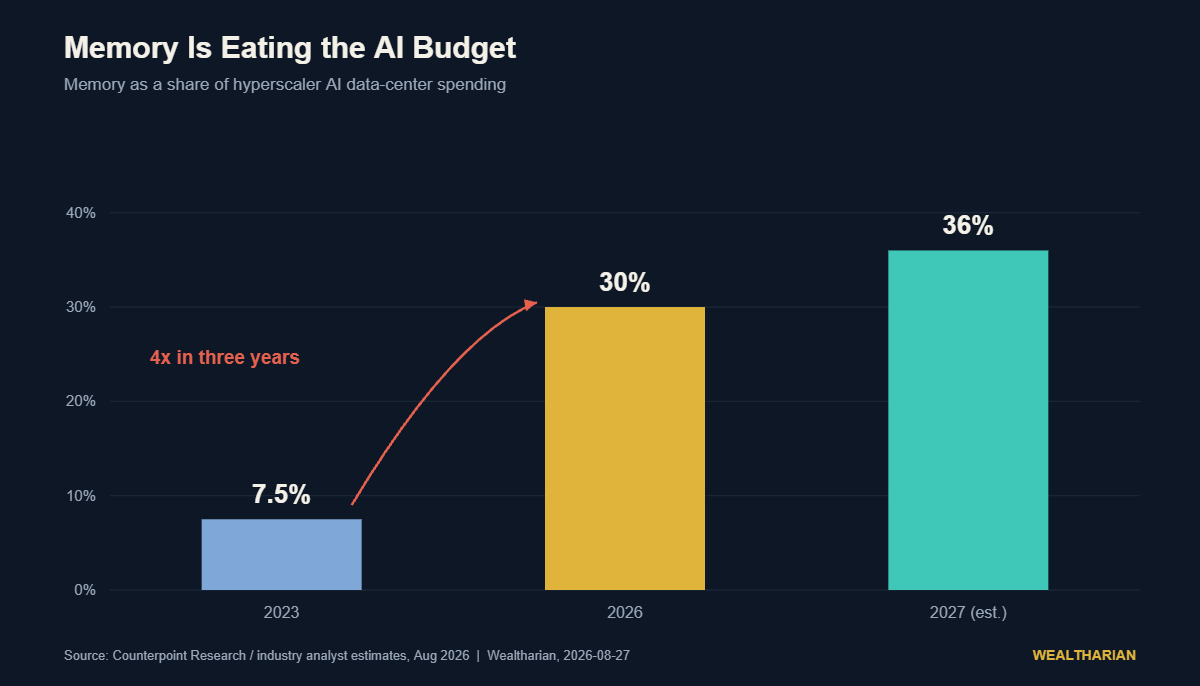
Deloitte now expects hyperscaler capital expenditure to exceed $1 trillion in 2026 — more than double what those same companies planned in January. A rising share of that trillion does not buy accelerators. It buys DRAM.
The mechanics are unforgiving. High-bandwidth memory, the stacked DRAM that sits beside every AI accelerator, carries roughly a three-to-one consumption ratio against ordinary DDR5 capacity. Every wafer a fab redirects to HBM removes about three times as much equivalent commodity DRAM from the market. HBM is expected to remain undersupplied through at least calendar 2027. Micron’s HBM capacity is reportedly sold out through 2027. SK Hynix’s chairman has warned that global memory supply will likely sit around 20% below demand through 2030.
That is not a shortage. That is a structural regime change in the cost of building intelligence.
Memory behaves nothing like GPUs
This is where most AI commentary goes wrong. People assume a shortage attracts supply and resolves itself. Memory does not work that way, for three reasons.
The supply base is three companies. Samsung, SK Hynix and Micron. After a decade of brutal commodity cycles that destroyed capital, all three underbuilt. There is no fourth entrant waiting in the wings.
New capacity takes years, not quarters. A leading-edge memory fab is a multi-billion-dollar, roughly three-year project. Meaningful relief is unlikely before late 2027 or 2028, and Deloitte’s own analysis suggests the crunch could persist to 2029 or 2030.
Not everyone pays the same price. Analysts report Nvidia secures preferential memory supply at rates well below the standard market. Someone absorbs that discount, and it is not the memory makers. It is every other buyer — including the hyperscalers, the PC builders and eventually you.
Which leads to the contrarian conclusion. The AI capex number has quietly become a price index, not a volume index. When Amazon raised its 2026 capital expenditure guidance from $200 billion to $220 billion and explicitly cited rising memory prices, that extra $20 billion bought no additional compute. It bought the same compute at a higher clearing price. Markets cheered it as a demand signal. It was partly an inflation signal.
Where this stops being an abstraction
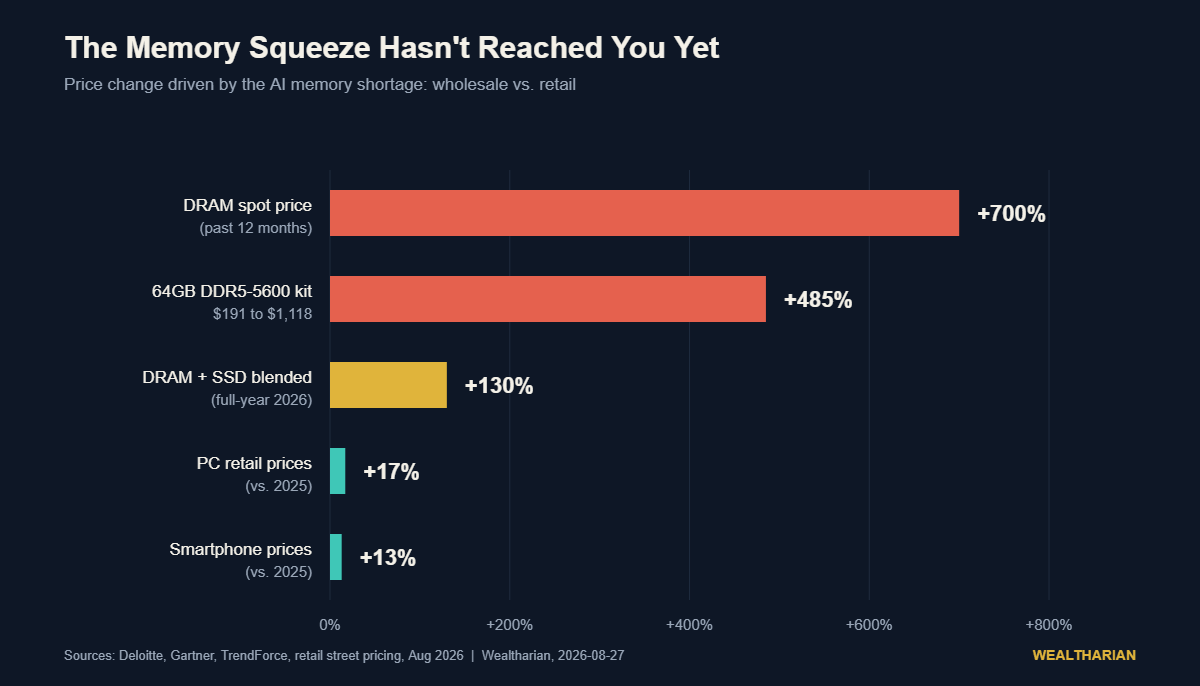
DRAM spot prices are up roughly 700% over the past year. A 64GB DDR5-5600 kit that averaged $191 in August 2025 averaged about $1,118 this month — a 485% increase. Gartner expects combined DRAM and SSD costs to climb around 130% across 2026, which translates into PC prices roughly 17% higher and smartphone prices roughly 13% higher than 2025. Sony has already raised the PS5’s price a second time and named memory costs as the reason.
Read the chart again and notice the gap. Wholesale memory is up several hundred percent. Retail devices are up in the teens. That gap is being absorbed, for now, by manufacturer margins — and margins are not a renewable resource.
This is the part worth being honest about. AI is creating enormous genuine value: faster drug discovery, better diagnostics, real productivity gains for ordinary workers. We have argued before that the collapsing cost of intelligence is one of the great wealth events of the century. But value creation and value capture are different questions, and right now a trillion dollars of capital is bidding against your laptop for the same silicon. That is not a moral failing. It is a fact you should be positioned for rather than surprised by.
What this actually means for your money
1. Stop reading capex as pure demand. When a hyperscaler raises spending guidance, ask whether it is buying more compute or the same compute at a higher price. Those are opposite signals for the companies buying it.
2. The bottleneck collects the rent — but bottlenecks are cyclical. Micron and SK Hynix have been among the best-performing large caps of the year for good reason. Note, though, that Micron trades near 5.5x estimated fiscal 2028 earnings and SK Hynix near 3.5x. Those are not bargain multiples. They are the market telling you it believes these are peak earnings. Memory has broken more portfolios at the top of the cycle than at the bottom.
3. Check what you actually own. If your index fund is heavily weighted toward the same handful of names funding this buildout, you are levered to a single capex cycle whether you chose that or not. We covered the math on record index concentration and it has not improved.
4. Buy the durable electronics you genuinely need now. Unglamorous, but the highest-certainty item on this list. If a laptop, phone or workstation upgrade is coming in the next 18 months, the memory in it is not getting cheaper before 2028.
The number to watch next
Fed Chair Kevin Warsh delivers his first Jackson Hole keynote this week, under the theme “Financial Innovation and Policy,” and that will dominate the headlines. Fine. But for this thesis, watch two things instead: the memory line in the next round of hyperscaler capital expenditure disclosures, and Micron’s next print. If memory’s share of AI infrastructure spending keeps climbing toward that 36% estimate, the AI boom stops being a story about who builds the smartest model and becomes a story about who controls the scarcest commodity.
Nvidia won the quarter. The memory oligopoly may be winning the decade.
Want to track your own path to financial independence? The Wealtharian Wealth Tracker lets you monitor your net worth, FU money progress, and investment milestones in one place. Try it free →