
On Wednesday the market decided July’s inflation report was good news and cut the odds of a September Fed rate hike to 42%. Almost nobody looked one meeting further out, where December is sitting at 73%.
That is the entire story in two numbers. The hike did not get cancelled. It got rescheduled. And the gap between those two readings is where a lot of household money is quietly being mispositioned right now, because most people are still running a financial plan built for a cutting cycle that has not arrived and, on current pricing, is not the next thing coming.
What the market actually priced
The July CPI print landed on 12 August almost exactly where economists expected it. Headline prices rose 0.1% on the month, putting the annual rate at 3.4%, down from 3.5% in June. Core CPI rose 0.2% on the month and 2.5% year over year.
Cool enough. Traders responded by cutting the probability of a September move to 42% on CME’s FedWatch tool, from roughly a coin flip going in. Headlines wrote it up as inflation easing and the Fed backing off.
Then look at the rest of the curve. October hike odds sit above 53%. December sits at 73%.
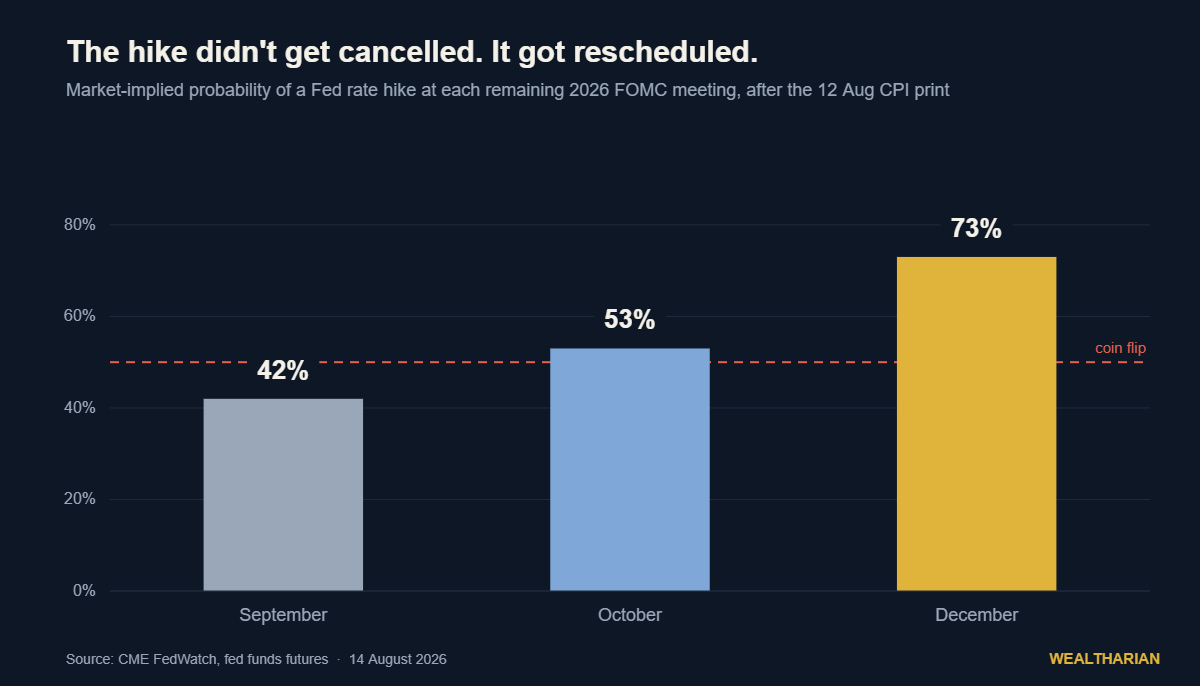
A market that genuinely believed inflation was beaten would not carry a 73% probability of tightening into year-end. What actually happened is narrower and less comforting: one soft print bought the Fed a meeting of breathing room. The direction of the next move never changed.
Why a Fed rate hike is even on the table in 2026
This is the part that still surprises people who stopped paying attention in 2024. The Fed has been holding at 3.50% to 3.75%, and the July FOMC decision to stay there passed 9-3. All three dissenters wanted to go up.
Two forces are driving it. The first is energy. The conflict around Iran has kept supply chains near the Strait of Hormuz from normalising, holding energy costs elevated. Oil was around $80 a barrel in early August; J.P. Morgan’s strategists sketch a path toward $120 if blockades persist, with genuinely recessionary territory only above $140.
The second is credibility. Chair Kevin Warsh has offered markets very little forward guidance, and after July’s hold investors began asking whether the committee is quietly tolerating 3%-ish inflation rather than fighting it. That question is expensive. It showed up immediately in bonds: after the July meeting, short-term yields drifted lower while long-term yields rose sharply, with the 30-year Treasury touching its highest level since 2007.
That shape matters. When the long end sells off while the front end rallies, the market is not forecasting growth. It is demanding more compensation for holding duration because it no longer trusts the inflation path. A September or December hike, in that framing, is not a response to an overheating economy. It is a credibility payment.
The playbook that has been wrong for four years
Here is the contrarian part, and it has nothing to do with predicting the Fed.
Since 2022, an enormous amount of ordinary financial behaviour has been organised around one assumption: rates are temporarily high and will come back down. Take the mortgage now and refinance later. Delay the move until borrowing gets cheaper. Keep the business expansion on hold. Sit in cash and wait for the entry point. Buy long-duration bonds ahead of the cuts.
Every one of those is a bet on a forecast. Every one of them has been wrong for four consecutive years. And the cost is not theoretical, it is compounding: four years of a deferred decision is four years of a deferred return.
The reflex is understandable. Anyone who built financial intuition between 2009 and 2021 learned that cheap money is the resting state of the world and expensive money is the anomaly you wait out. That intuition is now the single most expensive thing in a lot of portfolios. Rates at 3.50% to 3.75% with inflation at 3.4% is not an anomaly. On any long historical view, it is unremarkable. The 2010s were the anomaly.
The useful move is not to flip the forecast and start predicting hikes. It is to stop having a plan that requires a forecast to work.
The highest risk-free return most people never take
While everyone waits for the Fed to do something, there is a return sitting in plain sight that requires no view on rates at all.
The national average savings account paid 0.38% in July. The best high-yield accounts paid up to 4.21%. Same money, same insurance, same instant access. The gap is roughly 3.8 percentage points, available to anyone willing to spend twenty minutes opening an account.
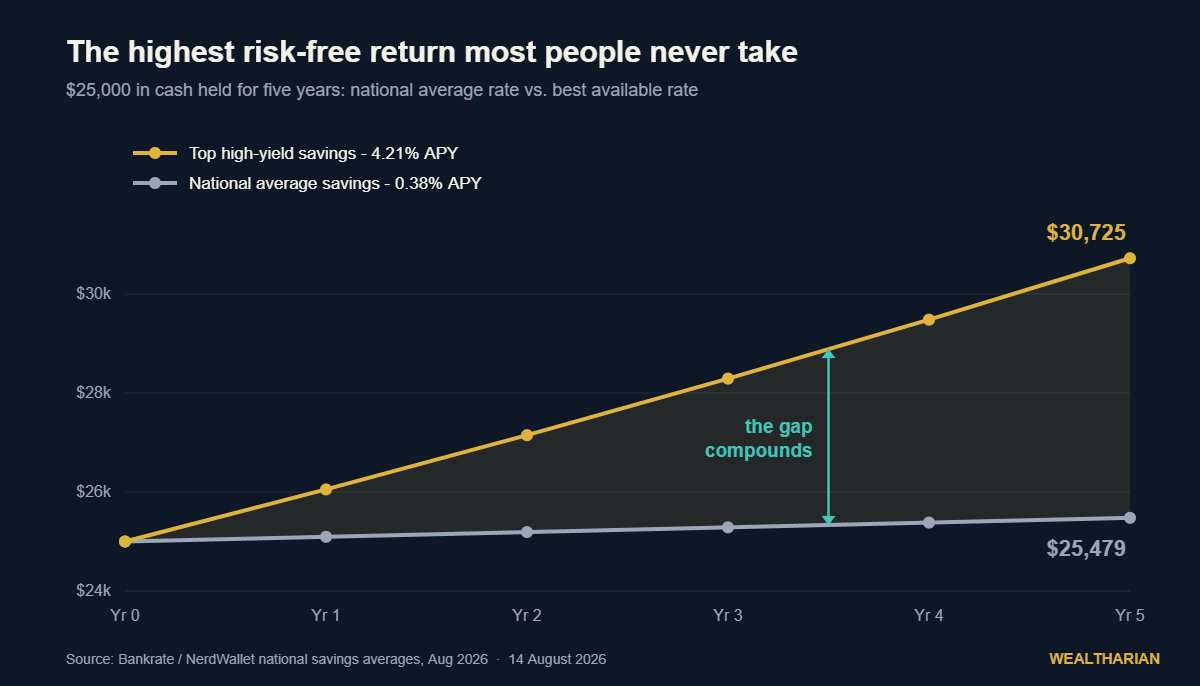
On $25,000 held for five years that is $30,725 versus $25,479. A difference of $5,246, earned by doing nothing except refusing the default.
Now set that against how the household sector is actually behaving. The personal savings rate is forecast to fall to around 4.8% this year as inflation, housing costs and debt service eat into disposable income. Credit card balances did dip $25 billion in the first quarter to $1.25 trillion, but they remain $70 billion higher than a year ago, and APRs sit near record highs. We covered why that headline decline was less encouraging than it looked.
And Gallup found in April that 51% of Americans have used instalment plans for online purchases, with about 27% using them frequently or occasionally. Among households earning under $48,000 that rises to 37%. Among people worried about making their credit card payments, 57%.
Read those together and the picture is uncomfortable: a large share of households are financing consumption at high rates while leaving nearly four points of guaranteed return on deposits they already hold. In a higher-for-longer regime, the spread between the rate you pay and the rate you accept becomes one of the biggest determinants of net worth, and it is almost entirely within your control.
What this actually changes in a portfolio
Three things follow, none of which require knowing what Warsh does in September.
Duration is a position, not a default. If you hold a total bond fund, you own a specific bet on long rates falling, whether or not you chose it. That is worth understanding rather than inheriting, and we wrote about how passive allocations quietly accumulate active exposures.
Cash is a real asset class again. At 4%+ it is not dead money, but only at the rate you actually get. The gap between the average and the best is larger than most people’s expected equity risk premium.
Diversifiers have already repriced. Gold is up over 25% year to date, driven by central bank buying and inflation hedging rather than retail enthusiasm. The hedge has been working, which also means it is no longer cheap.
The Wealtharian take
The 42% number was reported as a reprieve. It was a delay. Between a 73% December probability, three FOMC members already voting for a hike and a 30-year yield at 2007 highs, the honest reading is that the era of waiting for cheap money to return is over as a planning assumption, even if a cut eventually arrives.
The people who compound through this will not be the ones who called the September meeting correctly. They will be the ones who stopped organising their finances around a rate forecast and started taking the returns that were sitting there the whole time. That distinction, between wealth built on positioning and wealth built on prediction, is increasingly what separates outcomes in this economy, and it is the same divide we traced in the K-shaped economy that now runs on portfolios rather than paychecks.
Stop waiting for the Fed. It is not coming to rescue your plan.
Want to track your own path to financial independence? The Wealtharian Wealth Tracker lets you monitor your net worth, FU money progress, and investment milestones in one place. Try it free →