
The best high-yield savings account in America right now pays 4.50% APY. After federal tax and 3.4% inflation, it pays you 0.02%. That is not a typo, and it is not a rounding error — it is the entire story of the last five years compressed into one number.
Everybody is arguing about whether the Fed cuts in September. Almost nobody is arguing about the thing that already happened: the real return on cash has been negative or nil for five straight years, and the money that was taken during that stretch is never coming back. Not “probably not.” Not “unless policy changes.” By design.
Disinflation is not deflation — and the difference is your net worth
July CPI came in at 3.4% annual, with core at 2.5%. The headlines called it cooling. Fine. But “cooling” describes the rate at which prices rise. Wealth is destroyed at the level.
The Federal Reserve targets 2% inflation, not a 2% price path. That distinction sounds like central-bank pedantry until you draw it. Since 2021, cumulative US inflation has run 23.2%. Had prices followed the 2% target exactly, they would be up 10.4%. The gap is 12.8 points — and there is no mechanism anywhere in the Fed’s mandate designed to close it.
| Year | Actual US price level (2021 = 100) | If inflation had run at 2% | Gap |
|---|---|---|---|
| 2021 | 100.0 | 100.0 | 0.0 |
| 2022 | 108.0 | 102.0 | 6.0 |
| 2023 | 113.4 | 104.0 | 9.4 |
| 2024 | 116.8 | 106.1 | 10.7 |
| 2025 | 119.6 | 108.2 | 11.4 |
| 2026 | 123.2 | 110.4 | 12.8 |
A dollar you were holding in 2021 buys 81 cents of goods today. To get the price level back to the 2% path, the Fed would have to engineer years of deliberate deflation — which every central banker on earth considers a catastrophe worse than the inflation itself. So they won’t. “We beat inflation” means “the transfer has slowed to a permitted pace.”
Run the numbers on your cash. They are worse than you think.
Here is where it gets uncomfortable. Take today’s actual rates, subtract a 24% federal marginal tax on the interest, then subtract 3.4% CPI.
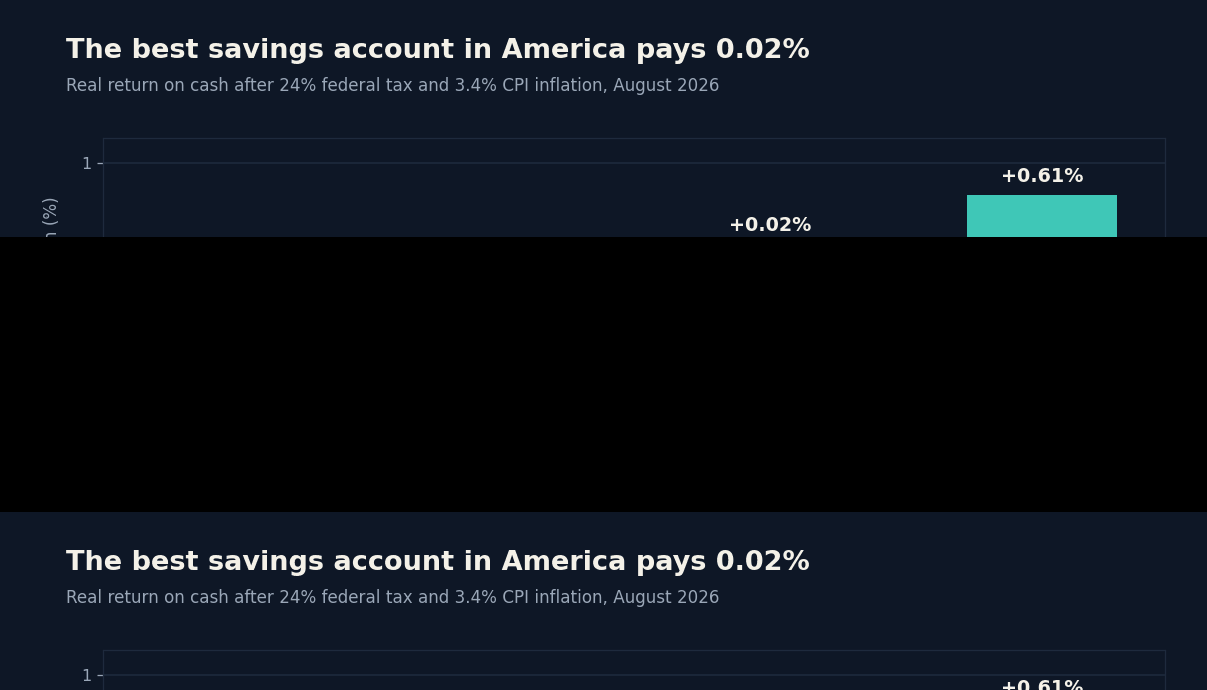
- The national average savings account (0.63% APY): −2.92% real. You are paying the bank almost 3% a year for storage.
- A typical top-tier HYSA (4.15%): −0.25% real. Still losing.
- The best HYSA in America (4.50%): +0.02% real. Congratulations.
- The 30-year Treasury (5.28%): +0.61% real — and you have to lock up capital for three decades to earn it.
Read that again. The single most competitive cash rate available to a US saver, after tax and inflation, is statistically indistinguishable from zero. And this is the good era for savers — the one everyone spent 2023 celebrating after a decade of ZIRP. The celebration was measuring the wrong number the whole time. (We made a related argument about the long end in the 30-year TIPS real yield hitting 3%.)
The contrarian part: you were repriced. You didn’t reprice back.
Here is the move almost nobody makes, and it is worth more than any asset-allocation decision you will make this year.
Between 2021 and today, every input to your life repriced upward by roughly 23%. Groceries. Rent. Insurance. Your accountant. Your landlord’s mortgage. The company that sells you software. They all raised prices — quietly, steadily, without asking permission.
Did you?
If you are a freelancer still quoting your 2021 day rate, you have taken a 19% pay cut and signed off on it. If you run a business and your price list hasn’t moved 20%+ since 2021, you have donated your margin to your customers. If you’re an employee who has received cumulative raises of less than 23% over five years, your “raise” was a demotion in real terms.
This is the asymmetry that makes inflation so effective as a wealth transfer: the price of everything you buy is repriced automatically, and the price of what you sell is repriced only if you personally do something about it. Institutions have pricing committees. You have a vague sense that asking for more feels awkward.
The single highest-return financial act available to most people in 2026 is not finding a better ETF. It is raising their own prices by 20% and holding the line. That is a permanent, compounding, tax-advantaged (it grows the top line, not just interest income) adjustment — and unlike markets, you control it. We made a version of this case when the AI wage premium hit 62%: the biggest lever on most balance sheets is still the income line, not the portfolio.
Who actually won the last five years
Every wealth transfer has a receiving end. Three groups collected:
1. Fixed-rate debtors. The person who “overpaid” for a house in 2021 and locked a 3% mortgage has watched the real value of that debt shrink by roughly a fifth while their wage and their home’s nominal price both drifted up. They were mocked for buying the top. They were the biggest single beneficiary of the last five years. Fixed-rate debt is a short position on the dollar, and the dollar fell 19%.
2. Owners of things with nominal revenue. Equities reprice with the price level because company revenues are quoted in current dollars. The S&P 500 closed at 7,681 on August 21 — up 61% nominally from its end-2021 level of 4,766, which is +31% after adjusting for the 23.2% price rise. Not spectacular for five years. But it is one of the very few places real capital actually grew.
3. Anyone who indexed their own income. See above.
The losing end was uniform: cash holders, fixed-nominal-income retirees, long-duration bondholders who bought in 2021, and anyone who quietly absorbed higher costs without pushing them through. That last group is much larger than the first three, and it includes a lot of people who think of themselves as financially responsible — which is precisely why the household stress showing up in credit data is measuring something deeper than bad budgeting.
What to actually do
Hold cash for its job, not for its return. An emergency fund exists to prevent forced selling and forced borrowing. That is a genuine function worth paying 0–3% a year for. Just stop calling it “saving” and start calling it what it is: insurance with a premium. Anything above 6–12 months of expenses sitting in cash is not conservative — it is a slow, certain loss dressed as prudence.
If you must hold cash, hold it at the top of the market. The gap between 0.63% and 4.50% is 3.87 points a year of pure, free, no-risk-taken return. Moving $50,000 from a legacy savings account to a top-payer is worth about $1,900 a year for roughly twenty minutes of work. There is no investment idea in this article with a better hourly rate.
Index the things you control. Rates, salary, rent you charge, product prices. Once a year, mechanically, without agonizing. If you need a rule: raise by the trailing three-year CPI, minimum.
Own assets whose cash flows are quoted in current dollars. Broad equities, real assets, TIPS at the long end, and your own business are the four things that reprice with the price level rather than against it.
The uncomfortable summary
The last five years were not an inflation crisis followed by a recovery. They were a permanent, one-time, 23% repricing of the world, conducted without a vote, and a subsequent agreement among everyone in charge that we would simply keep going from the new level.
You cannot undo it. You can stop volunteering for the next one.
Want to track your own path to financial independence? The Wealtharian Wealth Tracker lets you monitor your net worth, FU money progress, and investment milestones in one place. Try it free →