
On Thursday, OpenAI’s CFO told investors something the market has wanted to hear for three years: enterprise AI revenue has now overtaken consumer revenue at the most consumer-facing AI company on earth. Wall Street read it as the final proof that artificial intelligence has a real business model. Read the same disclosure alongside OpenAI’s own research from three days earlier, and it says almost the opposite.
The AI trade just changed hands. It went from millions of individuals paying $20 a month for something they personally found useful, to a few thousand procurement committees signing seven-figure contracts for something most of them still cannot prove works. Those two revenue streams look identical on an income statement. They behave nothing alike in a downturn.
What actually changed
The numbers are worth laying out precisely, because the trajectory is the story.
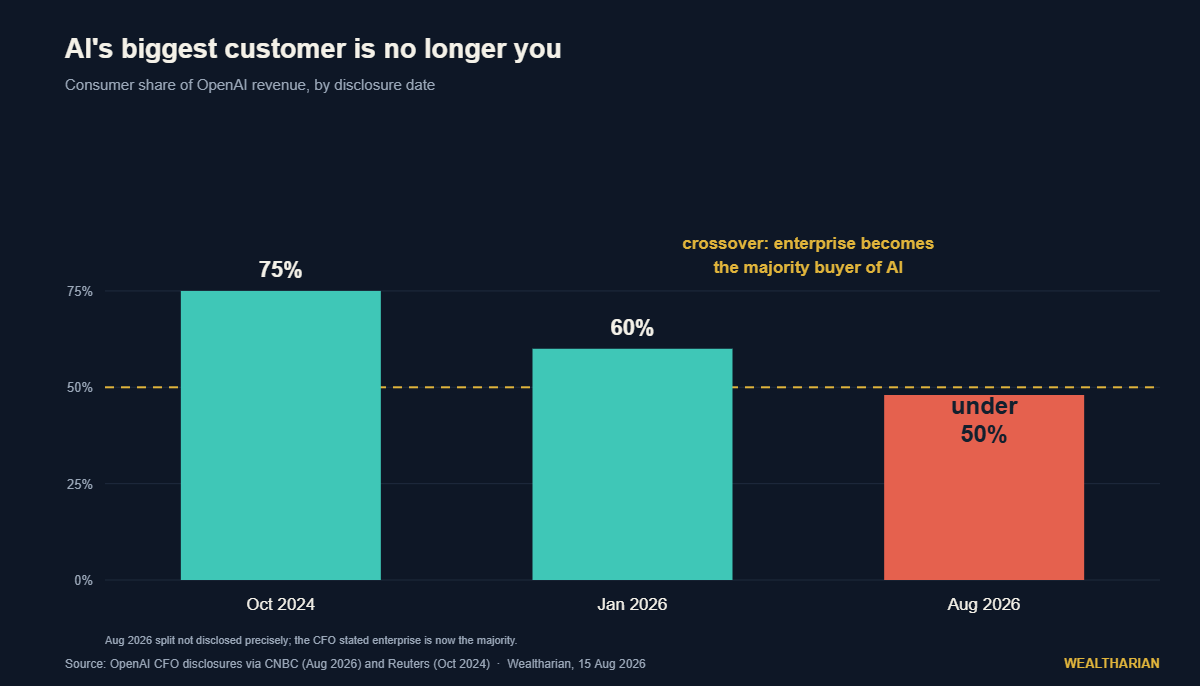
In October 2024, roughly 75% of OpenAI’s revenue came from consumer subscriptions — people buying ChatGPT Plus with their own money. The company entered 2026 at roughly 60/40 consumer-to-enterprise. As of this week, CFO Sarah Friar has told investors that enterprise is now the larger half. Her earlier public guidance had the two businesses reaching parity by the end of 2026. It happened four months early.
Meanwhile the top line roughly doubled. OpenAI closed 2025 with an annualized run rate above $20 billion; reporting this month puts it near $40 billion. So this is not a story of consumer revenue stalling. Consumer grew. Enterprise simply grew faster — driven by agent products, ChatGPT Work, and the Codex coding tool landing inside corporate workflows.
By any conventional reading, that is a bull signal. Enterprise revenue is supposed to be the good kind: contracted, annual, expansion-friendly, insulated from a consumer who cancels a subscription when the electricity bill arrives. It is the reason software multiples exist.
The contrarian read: this makes AI revenue less durable, not more
Here is the part nobody said out loud on Thursday.
Consumer revenue is millions of tiny, independent decisions. Each one is made by a person who tested the product against their own experience and concluded it was worth twenty dollars. That revenue is diversified across an enormous number of uncorrelated payers, and — critically — every one of those payers has already verified the value personally.
Enterprise revenue is the opposite on all three counts. It is concentrated in a small number of large contracts. Those contracts are approved by committees, not users. And the buying decision is not made by anyone who has measured the return, because in most companies, nobody has measured the return.
That last point is not a suspicion. It is documented — by OpenAI.
Page 35
On August 11, OpenAI published a 69-page study of how enterprises actually use ChatGPT. The headline findings are triumphant: exponential usage growth across every seniority level and job function, and a widening “frontier gap” between companies that adopt AI and companies that don’t.
Then, in a small table on page 35, the researchers report that revenue per employee shows no statistically significant relationship with how intensively those employees use AI, once you control for other variables. In their words, revenue per employee “is not meaningfully associated with output tokens per employee or messages per active user.”
Sit with that. The company selling the product ran the study, and its own data could not find a link between how much of the product a workforce consumes and how much revenue that workforce produces. Usage is exploding. The output metric that would justify the usage isn’t moving with it.
This isn’t proof that AI doesn’t work. It is proof that usage is not evidence — and usage is precisely what the enterprise AI market currently bills on.
The rest of the evidence points the same way
OpenAI’s page 35 is one data point. It sits inside a pile of others that all describe the same gap between spending and proof:
- MIT’s NANDA initiative found 95% of generative AI pilots deliver no measurable ROI, with the failure traced to integration and misaligned priorities rather than model quality.
- Roughly 42% of companies abandoned most of their AI projects in 2025 — more than double the prior year.
- Average enterprise AI spend ran about $7 million in 2025 and is projected near $11.6 million in 2026, a 65% increase.
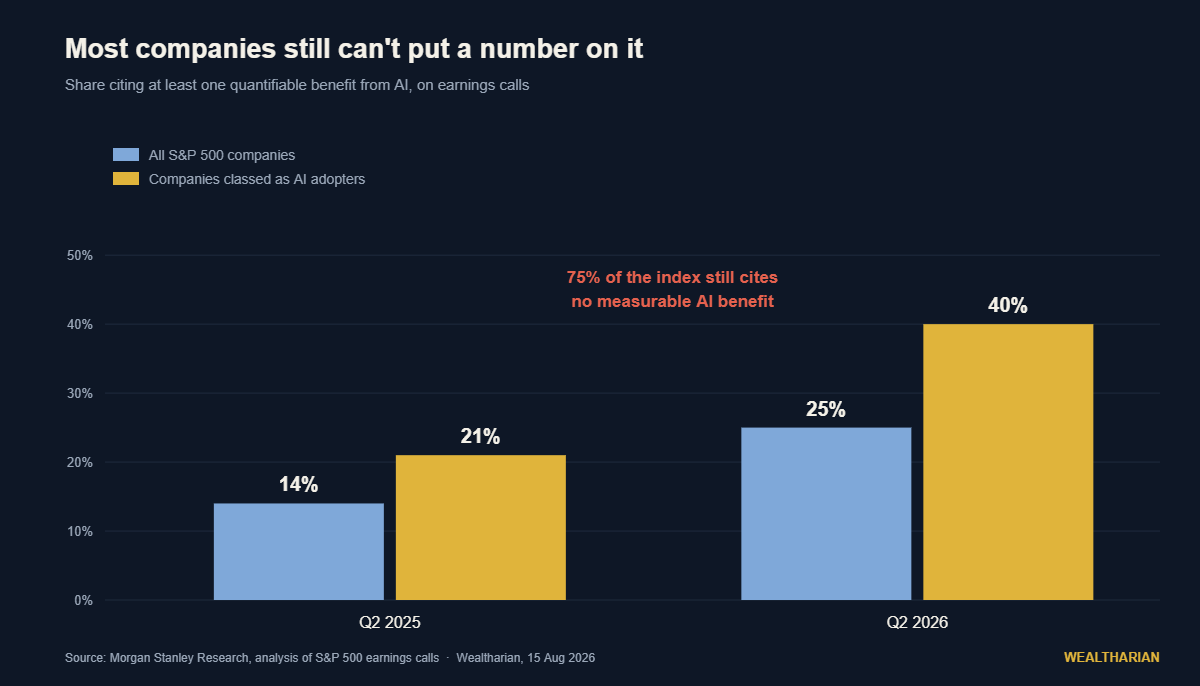
- Morgan Stanley’s analysis of earnings calls found that in Q2 2026, only 25% of S&P 500 companies cited a measurable benefit from AI.
Put the last two together and you get the sentence that defines this market: budgets are up 65%, and three quarters of the index still cannot point to a number.
We covered the earlier version of this gap in The AI ROI Gap. What is new this week is who is on the hook for it. When the spending was capex by five hyperscalers, the risk sat with five balance sheets that could absorb it. Now it is opex spread across thousands of ordinary companies whose CFOs have to defend the line item at the next budget review.
But the gap is closing — and that’s the actual trade
The lazy conclusion here is “AI is a bubble, sell.” That’s wrong, and the same Morgan Stanley data shows why.
The share of S&P 500 companies citing a quantifiable AI benefit went from 14% in Q2 2025 to 25% in Q2 2026. Among companies already classified as AI adopters, it moved from 21% to 40%. That is a proof rate roughly doubling in twelve months. And the companies delivering measurable results are reportedly expanding cash-flow margins at around twice the global average.
So the market is not splitting into “AI winners and AI losers.” It is splitting into companies that can produce a number and companies that can only produce a narrative — and it is beginning to pay very differently for the two. That is the same mechanism we saw when Microsoft gained 8% and Meta lost 8% on the same night, on identical spending stories with different proof attached.
What this changes in a portfolio
Three practical shifts follow.
1. Stop buying “AI exposure.” Start buying disclosure. “AI exposure” is now nearly meaningless — every large-cap on earth claims it. The scarce, priceable thing is a company that puts a specific figure in its earnings deck: cost per ticket down 30%, sales cycle down eleven days, headcount flat on 20% more volume. Screen for the number, not the mention.
2. Treat AI vendor revenue as cyclical until proven otherwise. Recurring revenue that the buyer cannot justify is not recurring — it is a subscription awaiting its first serious budget review. That does not make AI vendors uninvestable. It means they deserve a cyclical multiple, not a utility multiple, until the ROI evidence catches up with the billings.
3. Watch the renewal cohort, not the bookings. Bookings tell you how good the sales team is. Net revenue retention twelve to eighteen months after a large enterprise deployment tells you whether the thing worked. Enterprise AI is only now producing its first meaningful renewal cohort. That data, arriving through 2027, is what actually settles this argument — and most investors are not watching for it.
If you’re wondering how much of your own portfolio already rides on this question, you probably own more of it than you think — a point we made in You Didn’t Buy the AI Trade. Your Bond Fund Did.
The same rule applies to you
There is a personal version of page 35, and it is uncomfortable.
Most people using AI heavily right now have not earned an additional dollar from it. They are more productive in a way they can feel and cannot demonstrate. That is exactly the position the average enterprise is in — and it is exactly the position that gets cut when budgets tighten.
The scarce skill in 2026 is not using AI. Usage is already universal and therefore worth nothing. The scarce skill is converting AI into a number somebody else will pay for: revenue attributable, hours removed, error rate reduced, capacity added without headcount. In a world where 95% of deployments fail, the person who can reliably land in the 5% is not a power user. They are the most valuable hire in the building.
That is a career arbitrage with a visible expiry date. Right now, “I use AI” still reads as a credential. Within a couple of years, only “here’s what it returned” will.
The bottom line
OpenAI crossing over to majority-enterprise revenue is genuinely a milestone. But it moved the AI economy’s centre of gravity from a customer who verified the value personally to a customer who mostly hasn’t. The revenue is real. The proof is still arriving — faster than the skeptics claim, slower than the price implies.
Invest accordingly: own the companies that publish the number, discount the ones that publish adjectives, and become, in your own career, the person who produces the number.
Want to track your own path to financial independence? The Wealtharian Wealth Tracker lets you monitor your net worth, FU money progress, and investment milestones in one place. Try it free →