
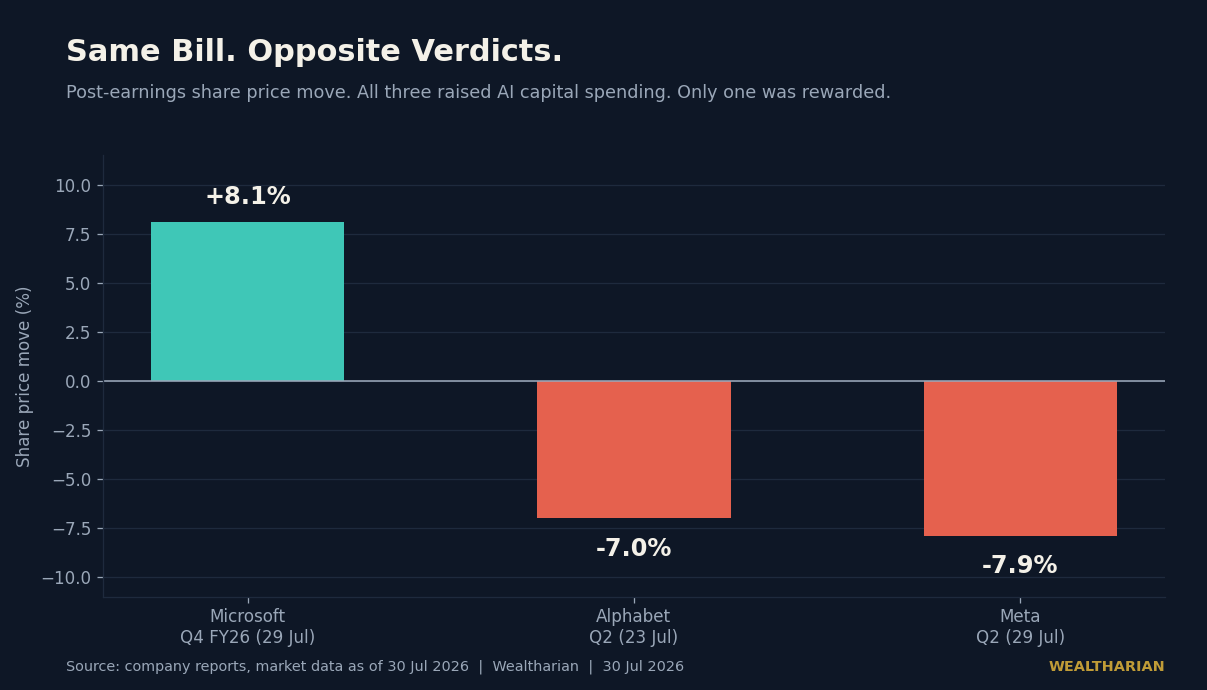
On the night of 29 July, two of the biggest spenders in corporate history reported earnings within minutes of each other. Microsoft told the market it would raise capital spending by roughly 35% next year — and the stock jumped 8%. Meta nudged up the floor of its spending range — and fell nearly 8%.
Read that again, because almost every headline this week got the story backwards. The market is not turning against AI spending. It has quietly changed what it measures. The AI capex payoff test is no longer “how much are you spending?” It is “show me the contract.”
What the AI capex payoff test actually measured this week
Start with the numbers, because they are the argument.
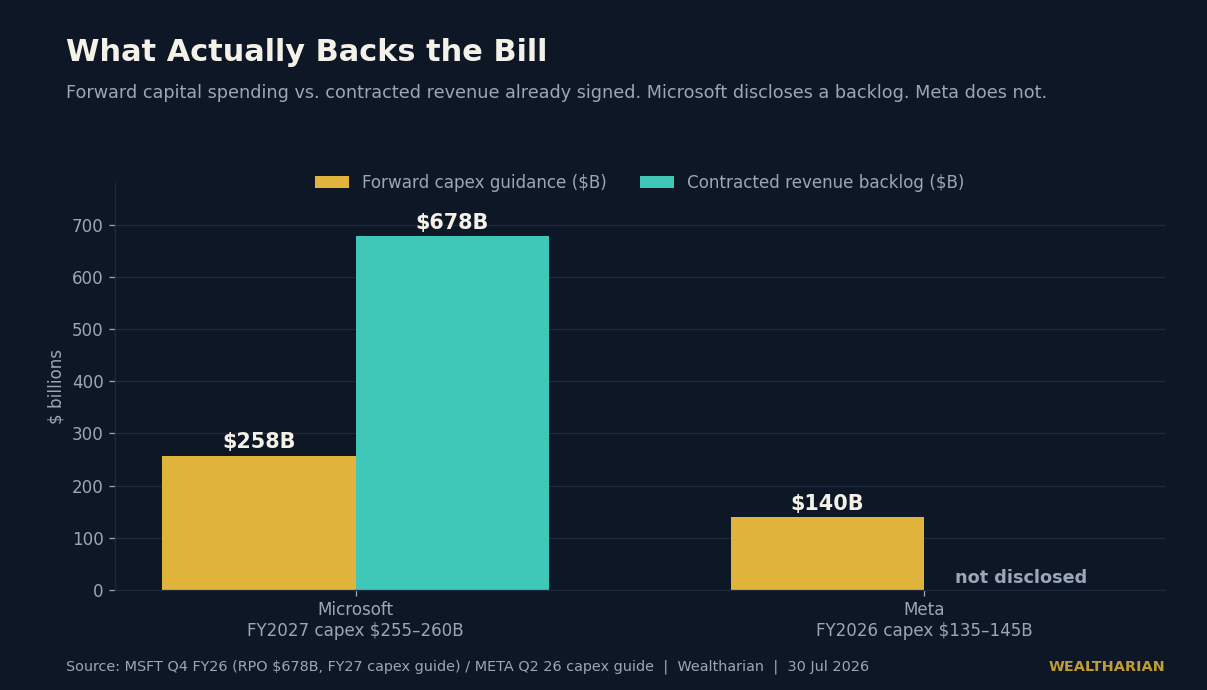
Microsoft, fiscal Q4: revenue of $90.01B against a $87.61B consensus. EPS of $4.74 against $4.24. Azure grew 43% and crossed $100B in annual revenue for the first time. Copilot reached 30 million paid seats. And the line that mattered most: commercial remaining performance obligation — signed, contracted revenue not yet recognised — hit $678B, up 84% year over year, and still up 25% if you strip out OpenAI entirely. Management then guided FY2027 capex to $255–260B, about 35% above the roughly $190B pace of calendar 2026. The stock rose 8% after hours.
Meta, Q2: revenue of $60.8B, up 28% and above consensus. EPS of $6.18 against $7.14 expected — a miss driven by a $2.4B legal contingency charge and $1.2B of severance. Adjust those out and Meta beat. Full-year capex guidance moved to $135–145B from $125–145B: the ceiling did not move, only the floor. The stock fell about 8%.
Meta’s operating business was arguably fine. Its disclosure was not. Meta spends $140B a year on compute and reports no contracted backlog against it, because it has no external customers for that compute — it is spending on itself, and asking shareholders to accept advertising improvements as the receipt.
The contrarian read: this is a repricing of proof, not of AI
The consensus story since Alphabet’s 7% drop on 23 July has been “the AI trade is cracking.” That is lazy. If the market were rejecting AI capex, the company announcing the single largest capex increase in the group would have been punished hardest. Instead it was the only one rewarded.
What actually happened is that investors moved from valuing the promise of AI to valuing the invoice. There are now three tiers, and the market has started sorting companies into them:
- Tier 1 — contracted demand. Someone else has legally committed to pay for the capacity. Microsoft’s $678B RPO. Cloud providers with signed multi-year commitments. Here, capex is closer to working capital than to speculation.
- Tier 2 — internal conviction. Spending on your own product with no external buyer. Meta. The return may be real and enormous, but it arrives as a diffuse improvement in ad performance, not as a line item you can audit.
- Tier 3 — spending to stay in the conversation. Everyone else building capacity because competitors are.
The premium between Tier 1 and Tier 2 opened up by roughly 16 percentage points in a single evening. That is the trade of the week, and it has nothing to do with whether AI works.
The detail almost nobody flagged
Buried in Microsoft’s commentary: the company will extend the assumed useful life of new offices and data centre buildings from 15 years to 25 years. That single accounting change spreads the same construction cost across a decade more of income statements, which mechanically lowers annual depreciation and lifts reported profit.
We wrote about exactly this mechanism two days ago — see the $200 billion line nobody reads. Useful-life assumptions are the quietest, most powerful lever in Big Tech’s earnings, and this week’s version was announced on a night the stock rose 8%, so nobody asked about it.
To be fair: 25 years for a building is a defensible estimate. Concrete does last longer than a GPU. But notice the pattern — servers get shorter lives as the chip cadence accelerates, while buildings get longer ones. Both directions happen to protect reported margin. If you own these companies, you should know that a meaningful slice of “record earnings” is an estimate, not a measurement.
The macro backdrop makes discipline non-optional
All of this is happening while money stopped getting cheaper. On 29 July the Fed held the funds rate at 3.50–3.75% for the fifth consecutive meeting, on a divided 9–3 vote, under new chair Kevin Warsh. Markets are now pricing two 25bp hikes — September and December — not cuts.
That matters because roughly a third of incremental hyperscaler capex is now debt-financed. When capital cost falls, unbacked spending is cheap optionality. When capital cost is flat-to-rising, unbacked spending is a fixed obligation against an uncertain return. The market repriced Tier 2 the moment the discount rate stopped helping. Our earlier note on who really pays for AI infrastructure covers the other half of that bill.
What to do with this
1. Stop trading the capex headline. The number itself carries almost no information now. Read the sentence after it — is there a backlog, a commitment, a customer? A 35% capex increase with $678B of signed revenue behind it is a different security than a 4% increase with nothing behind it.
2. Know what your index fund owns. If you hold a total-market or S&P 500 fund, you own both tiers, weighted by market cap, whether you agree with either capex plan or not. “I’m not making a call on AI capex” is itself a call — a market-cap-weighted one.
3. Watch the cash flow statement, not the EPS line. Alphabet’s negative free cash flow was the first real signal in this cycle. Depreciation assumptions can flatter earnings; they cannot manufacture cash.
4. Apply the same test to yourself. This is the part that actually compounds. Every serious wealth decision you make is a capex decision: a course, a rental property, a side business, a year of your time. The question the market just asked Big Tech is the one worth asking your own balance sheet — is there a contract behind this spend, or only a hope? Tier 1 personal investments have someone committed to paying you. Tier 2 investments feel productive and might be. The distinction is where most people’s money quietly goes to die, which is also the gap between saving a lot and actually getting wealthier.
The bottom line
The AI buildout is not unravelling. It is being audited. Capital is still available in enormous size to anyone who can show a signed counterparty, and it has become expensive for everyone who can only show conviction. That is not a bubble popping — that is a market growing up mid-cycle, which is a far healthier and far more dangerous thing to be standing in front of unprepared.
Apple and Amazon report today. Amazon guided to roughly $200B of capex this year. By the logic the market applied on Wednesday night, the only question that matters is what AWS says about backlog.
Want to track your own path to financial independence? The Wealtharian Wealth Tracker lets you monitor your net worth, FU money progress, and investment milestones in one place. Try it free →