
Wall Street has spent all of 2026 arguing about whether $425 billion of AI capital spending will ever earn a return. Meanwhile, AI has already produced a verified, measurable, repeatable 62% return — and it paid out in wages, not share prices.
The AI wage premium is the most important AI number of the year, and almost nobody is trading on it, because you cannot buy it through a brokerage account.
The one AI return that has already cleared
PwC’s 2026 Global AI Jobs Barometer analysed more than one billion job advertisements across 27 countries. Its headline finding: US workers with AI skills now command an average wage premium of 62% over otherwise comparable colleagues, up from 57% a year earlier. Jobs requiring specific AI skills are growing roughly eight times faster than the job market as a whole.
Now set that against the capex story. Amazon, Google, Microsoft and Meta are collectively spending about $425 billion on infrastructure this year — a 77% jump on last year’s $240 billion record. Microsoft is tracking toward $120 billion or more in fiscal 2026 and has disclosed an $80 billion backlog of Azure orders it cannot fill because it cannot get power. Meta raised full-year guidance to $125–145 billion. And as we argued when the AI trade quietly became a credit trade, incremental annual debt has gone from 9% of hyperscaler capex in FY24 to 32% by mid-2026.
One of these returns is banked. The other is a forecast attached to a bond issue. Guess which one the retail crowd is chasing.
Enterprises adopted AI. They never actually deployed it

The adoption headlines are enormous and the deployment reality is small. McKinsey finds 88% of organisations now use AI in at least one function — but only 23% are scaling an agentic system. S&P Global Market Intelligence puts the share of enterprises with at least one AI agent actually in production at 31%: 47% in banking and insurance, 18% in healthcare, 14% in government.
The returns column is worse. Only 29% of organisations report significant ROI from generative AI, and just 23% from AI agents. Gartner expects more than 40% of agentic AI projects to be cancelled outright by 2027, on unclear ROI and weak risk controls. This is happening at the same time as 80% of enterprise applications shipped or updated in Q1 2026 embedded at least one agent, up from 33% in 2024.
Read those two facts together and the picture is clear: the software raced ahead of the org chart. Vendors ship agents. Enterprises do not operate them.
So where did the productivity actually go?
Here is the part nobody wants to say out loud. AI “super-users” are measured at roughly 5x productivity gains. Only 29% of organisations see significant ROI. Those two numbers can only both be true if the gains are real but are not being captured at the company level.
They are being captured by individuals.
When one analyst quietly does the work of five and the employer has not rebuilt its processes, headcount plan or measurement to notice, that surplus does not evaporate. It reappears as slack time. As leverage in a review. As an outside offer at a 62% premium. As a second income stream the employer never sees. It is the largest quiet transfer of economic value this decade, and not one cent of it is intermediated by a brokerage.
The contrarian position: in 2026, the highest-conviction, lowest-capital AI trade available to an ordinary person is not buying the chipmaker. It is becoming the person the 62% is paid to. That trade requires no capital, has no drawdown, settles monthly, and is not correlated to the Nasdaq.
The premium is brutally uneven
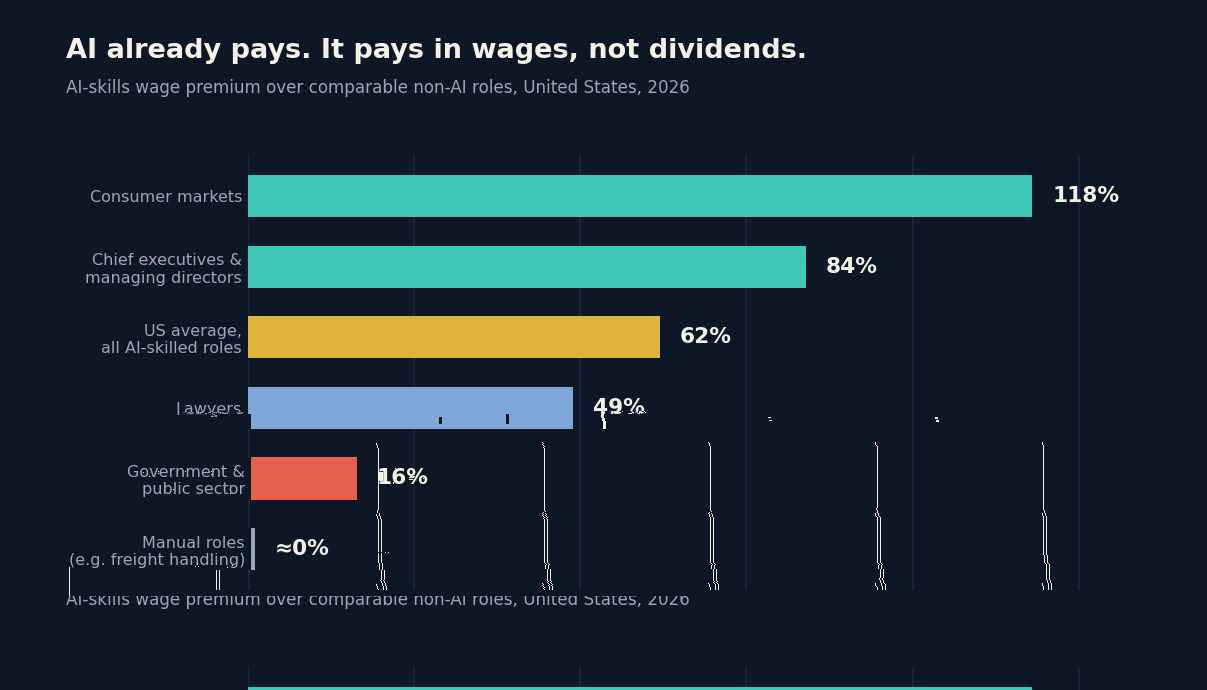
The average hides everything that matters. PwC’s US data show the premium running at 118% in consumer markets and 84% for chief executives and managing directors, against 49% for lawyers, 16% in government and the public sector, and effectively zero for manual roles such as freight handling. AI and ML engineers sit at a national median of roughly $170,000–$175,000, with senior specialists at $200,000–$310,000 in base pay before equity.
Look closely at that ranking. The premium is not paid for knowing how to use a model. It is paid for sitting in a seat where judgment scales — where one better decision moves a large number. AI multiplies leverage you already have. If your role has no leverage to multiply, the tool pays you nothing, and the honest advice is to change the seat before changing the software.
How to actually position
1. Work out which side of the line your role sits on. Not “will AI take my job” — that question is unanswerable and paralysing. The useful question is whether your output scales with better judgment. If yes, the premium is available to you. If no, your leverage has to come from ownership rather than wages.
2. Get the skill on the record. The premium is priced off job advertisements, which means it is paid for observable AI capability — shipped work, a named tool in a job title, a portfolio. Private competence earns nothing.
3. Convert the surplus rather than donating it. This is where most people lose. A 5x productivity gain absorbed as extra unpaid throughput is a gift to your employer. The same gain routed into a raise, a side income, or invested capital is how a wage premium becomes actual wealth — the difference between earning well and owning assets.
4. Keep the equity trade separate and size it honestly. None of this says avoid AI stocks. It says stop treating one uncertain bet as your entire exposure to a technology that is already paying you elsewhere. We made the same argument about concentration risk when enterprise revenue overtook consumer at OpenAI.
The obvious objection
Premiums compress. Scarcity rents always do — as AI skills become table stakes, the 62% narrows toward zero, and the people paid it today become the baseline of tomorrow. That is a real risk and it deserves a straight answer.
Two things follow. First, compression takes years, not quarters: the premium went up this year, from 57% to 62%, five years into the cycle. Second, and more importantly, compression is exactly why you convert the premium into assets while it exists rather than lifestyle. A wage premium that decays is still a windfall — if you bank it.
Meanwhile, the capex bet requires a payoff that, on today’s evidence, 77% of enterprises have not yet found. Markets already noticed: on 18 August the Nasdaq fell 1.3% and a closely watched semiconductor gauge dropped 5.5%, with the 30-year Treasury yield at its highest level in nearly two decades, partly on the weight of AI-related bond issuance.
The capex may still pay. The wages already did. Position accordingly.
Want to track your own path to financial independence? The Wealtharian Wealth Tracker lets you monitor your net worth, FU money progress, and investment milestones in one place. Try it free →