
In roughly three weeks, public markets erased about $1.5 trillion of semiconductor value — more than the GDP of Spain. In the same month, private investors marked Anthropic at $1.2 trillion and OpenAI at $933 billion. Same technology. Same economy. Two verdicts that cannot both be a clean read of reality.
Every AI bubble debate you’ve seen assumes there is one answer: it’s either a bubble or it isn’t. July 2026 just broke that framing. The Philadelphia Semiconductor Index is officially in a bear market, down roughly 24% from its late-June record, while the private AI labs it supplies are being marked at all-time highs — Anthropic’s secondary valuation is up about 550% in a year. If you want to build wealth through the AI era rather than get whipsawed by it, you need to understand why both of these things are happening at once.
Two markets, two verdicts
The public-market carnage is real and brutal. The SOX fell about 11% in a single week and is down nearly 24% from its end-of-June high. Nvidia, AMD, Applied Materials, Micron — all caught in the downdraft, with Intel down 21% on AI spending fears. Wall Street’s stated reason: growing skepticism that record AI capital spending will generate returns on the timeline investors modeled, compounded by a hawkish Fed that may hike rates this year and 10-year Treasury yields at 4.60%.
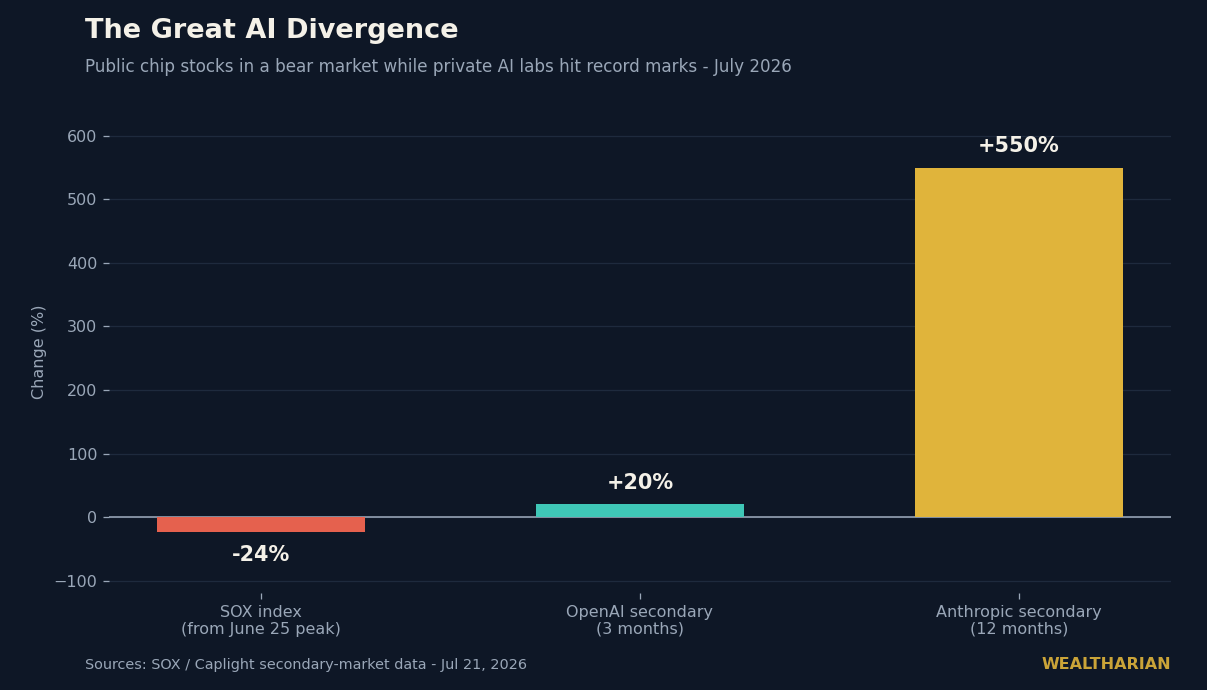
Now the other tape. On secondary markets — where employees and early investors sell private shares — Anthropic just crossed a $1.2 trillion implied valuation, overtaking OpenAI, a 550% surge in twelve months. OpenAI sits near $933 billion, up about 20% in three months on the back of its newest models. Private investors are not merely calm about AI monetization. They are paying record prices for it — during the exact weeks public investors are dumping the companies that build AI’s physical foundation.
The AI bubble question is the wrong question
Here’s the contrarian read: neither market is lying, because they aren’t pricing the same thing.
Public markets price cash flows, quarterly, under today’s monetary conditions. With CPI still at 3.5%, a Fed openly discussing a hike, and oil elevated on US–Iran tensions, the discount rate on far-future profits went up — and semiconductors are a cyclical industry being valued on the assumption that record capex continues forever. A 24% drawdown is what it looks like when that assumption gets stress-tested, not proof that AI is over.
Private secondaries price something else entirely: scarcity plus a story. Brokers describe a near-total absence of sellers of Anthropic and OpenAI shares. When nobody sells, every marginal desperate buyer sets a new “valuation” — no new revenue required. These marks are estimates from fragmented, illiquid trades, not continuously discovered prices. A $1.2 trillion mark on tiny volume is a very different fact than a $1.2 trillion market cap with billions of dollars of daily float.
So the honest answer to “is this an AI bubble?” is: the froth and the fear are both real, and both markets are giving you partial information. The public tape tells you the cost of capital has changed. The private tape tells you the smartest concentrated capital still believes the model layer wins big. Your job is not to pick a religion. It’s to notice what neither side disputes.
Follow the capex, not the narrative
What neither side disputes: the money is still flowing into AI infrastructure at historic scale. In the middle of this selloff, Meta signed a $21 billion deal with CoreWeave for compute capacity through 2032 and announced its own new AI chips. Microsoft committed Azure to AMD’s Helios AI racks — a live, monetizable design win, announced the same week “AI monetization skepticism” was the headline explanation for the crash.
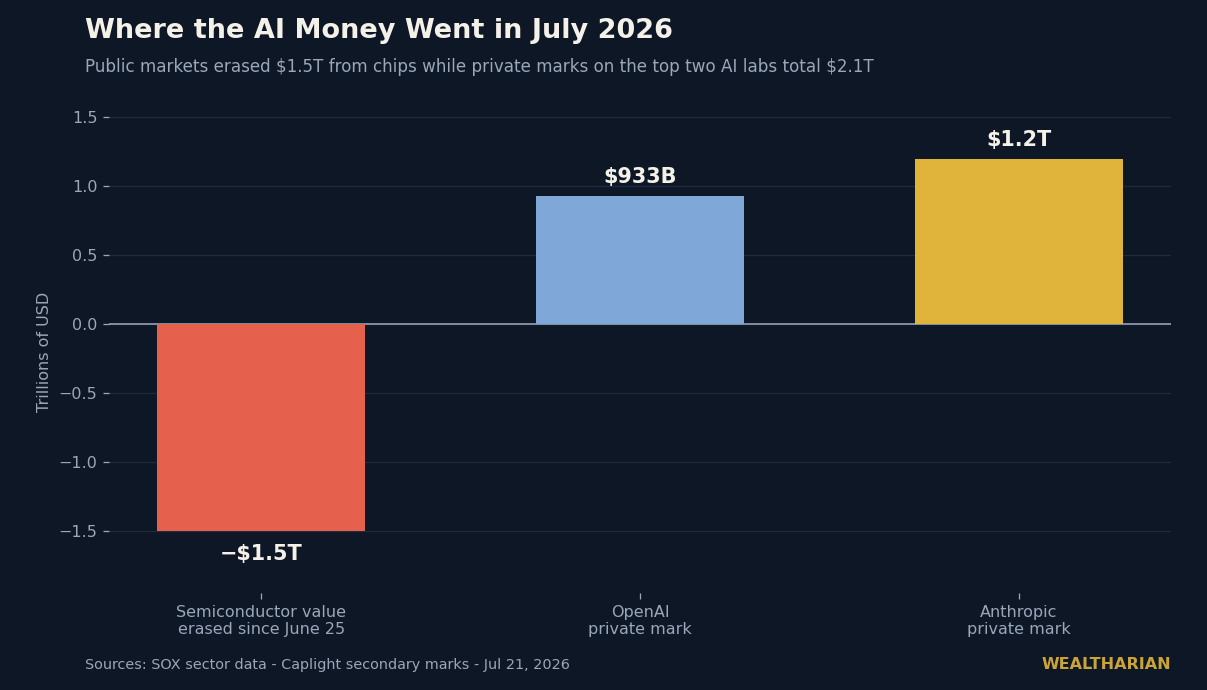
That combination — record spending, falling hardware stocks, record model-lab valuations — tells you what’s actually being repriced: who captures the profit. The market is no longer willing to pay any price for generic exposure to AI hardware, because buyers like Meta are vertically integrating (their own chips), diversifying suppliers (AMD alongside Nvidia), and locking in compute through long-term contracts that compress margins. Value is migrating toward the model layer, proprietary distribution, and the physical bottlenecks — power, advanced memory, data-center capacity — that can’t be commoditized quickly.
This is the same lesson every technology buildout teaches. Railroads transformed America while railroad stocks ruined two generations of speculators. The internet changed everything and the Nasdaq still fell 78%. The technology being real and the stocks being overpriced were both true. In 2026, the twist is that you can watch both halves of that truth trade in real time — one on the SOX, one on the secondary market.
The playbook for people who can’t buy Anthropic
Here’s the uncomfortable part for regular investors: the asset the private market says is the winner — the frontier labs — is one you mostly cannot buy. That asymmetry produces predictable mistakes. Don’t make them.
Don’t chase private marks through the side door. SPVs and pre-IPO funds offering “access” to OpenAI or Anthropic at these levels typically stack fees on top of an already scarcity-inflated mark. Buying an illiquid asset at its all-time-high estimate, at a markup, is not access — it’s exit liquidity with extra paperwork.
Treat the semi bear market as a repricing, not a verdict. A 24% drawdown in three weeks is the first genuine discount on the AI supply chain in over a year. That doesn’t mean buy indiscriminately — it means you finally get to be selective. Favor companies with real current cash flows, pricing power, and exposure to the bottlenecks (power generation, advanced memory, networking) rather than stories about 2030.
Position for the migration, not the moment. If value is moving to models and distribution, the public proxies are the hyperscalers that own both compute and customer relationships — and that can turn AI spending into recurring revenue today. They fell less than the chip names in this correction for a reason.
Keep your base rate honest. With the Fed hawkish and cash still yielding almost nothing at the average bank, your defense is the same as we argued in our breakdown of the 2026 inflation-hedge test: productive assets bought at sane prices, plus your own earning power — which AI, used aggressively as a tool, is currently compounding faster than any index.
We said during the first leg of this AI correction that volatility in the picks-and-shovels layer was the predictable price of a buildout this large. Three weeks and $1.5 trillion later, that’s no longer a prediction. The divergence is the opportunity: fear in the public market, euphoria in the private one, and a steady flow of capex receipts telling you the buildout itself hasn’t blinked.
Want to track your own path to financial independence? The Wealtharian Wealth Tracker lets you monitor your net worth, FU money progress, and investment milestones in one place. Try it free →