
Gold is up roughly 80% since early 2025. Bitcoin — the asset an entire generation was told to buy as “digital gold” — is down about 20% this year, with inflation running at 4.2%. For fifteen years, the inflation-hedge debate was theoretical, argued in podcasts and whitepapers while inflation sat at 2%. In 2026, reality finally ran the experiment. The results are in, and they’re brutal for one side.
This matters far beyond crypto Twitter. If you hold cash, stocks, bonds, or anything else denominated in dollars, 2026 is quietly repricing your savings every month. Understanding which inflation hedge actually worked — and more importantly why — is one of the highest-value lessons this decade will teach. Most people will learn it too late, at the top of the wrong trade.
The test nobody could simulate
Start with the conditions, because they’re the point. May CPI printed 4.2% year over year. The Fed’s preferred gauge, PCE, came in at 4.1% with core at 3.4% — all more than double the 2% target. Oil is back above $80 a barrel as US–Iran hostilities resumed, feeding inflation through every supply chain. And the Federal Reserve under new chair Kevin Warsh has not only taken rate cuts off the table — nine of eighteen officials now project at least one hike this year, with the median year-end rate forecast raised to 3.8%.
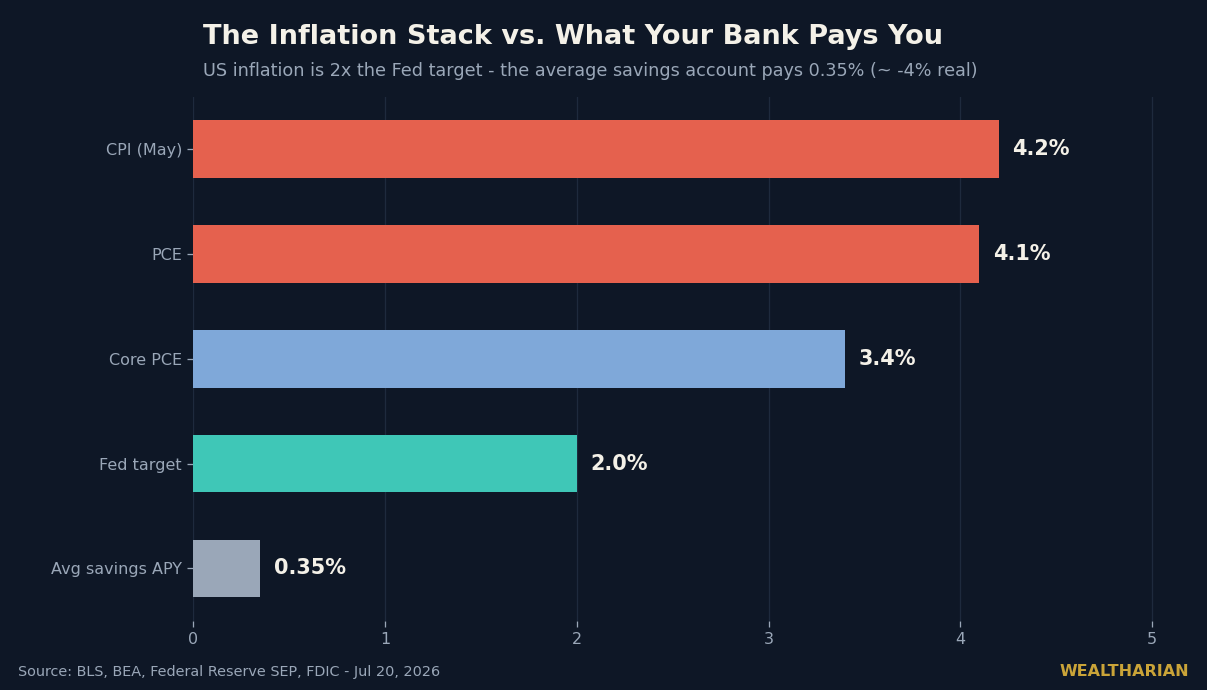
Read that again: sticky 4%+ inflation, a hawkish Fed, a geopolitical energy shock, and a resilient labor market (unemployment at 4.2%). This is the exact scenario every inflation-hedge thesis was written for. Not a backtest. Not a simulation. The real thing — the first sustained inflation-plus-crisis regime since the early 1980s.
The scoreboard: one hedge showed up
Gold did precisely what the brochure promised. It hit a record $5,589 an ounce in January and sits roughly 80% above its early-2025 level. Behind the price is a structural bid: central banks are on pace to buy around 755 tonnes in 2026 as governments diversify away from dollar-heavy reserves. When the US–Iran conflict flared in late February and energy spiked above $100, gold rallied — exactly the conditions it was built for.
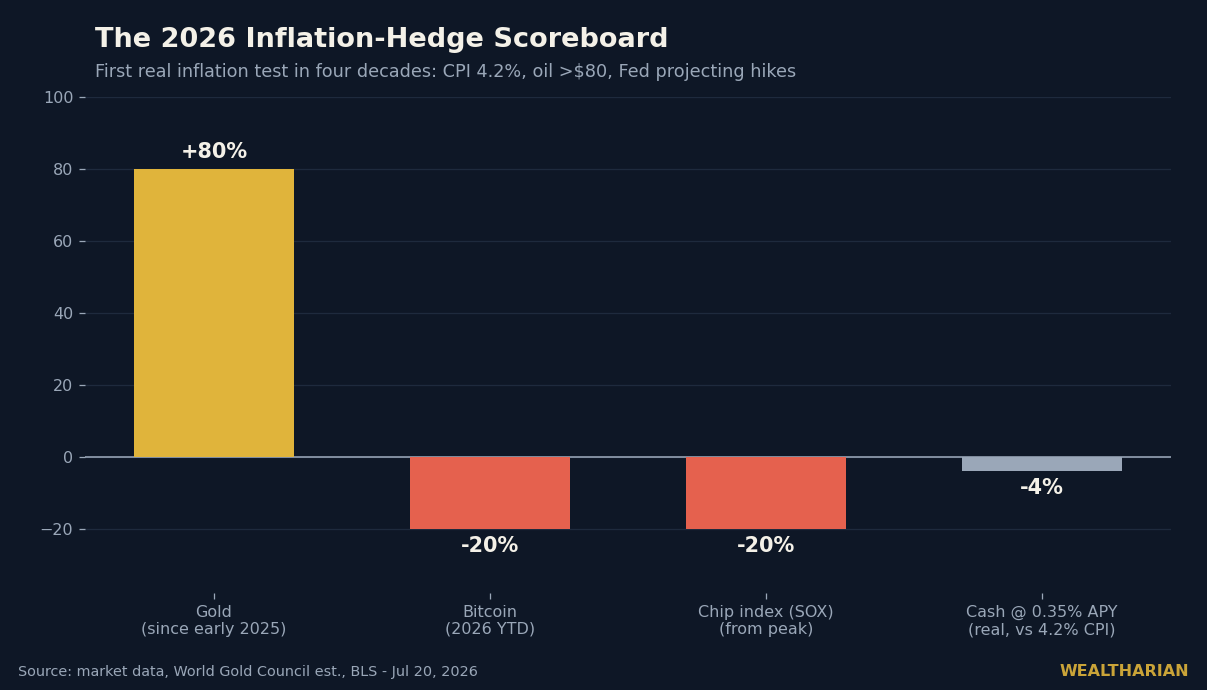
Bitcoin did the opposite. It’s down about 20% in 2026, trading near $65,000 — falling while inflation expectations rose and monetary policy turned restrictive. Research keeps finding the same pattern: Bitcoin drops sharply when financial uncertainty (the VIX) spikes. It surged after the one soft inflation print of the summer on July 15 — which tells you everything. An asset that rallies on disinflation news is not an inflation hedge. It’s a liquidity asset wearing an inflation-hedge costume.
And for completeness: cash failed hardest of all, silently. The average US savings account still pays about 0.35%. Against 4.2% inflation, that’s a guaranteed loss of nearly 4% of purchasing power a year — the one losing trade almost every household is fully invested in.
The contrarian read: Bitcoin didn’t fail — the label did
Here’s where we part ways with both camps. The gold bugs’ victory lap and the “Bitcoin is dead” obituaries make the same mistake: they treat “inflation hedge” as one job. It’s at least two.
Crisis inflation — war, energy shocks, supply chains, fear — is gold’s job, and 2026 proved it still owns that franchise. Slow debasement — years of money-supply growth, deficits, and currency erosion — is a different job, and over multi-year horizons Bitcoin has hedged that reasonably well: it remains massively above its pre-2020 levels precisely because the 2020–2021 money printing never got unwound. Bitcoin behaves like a leveraged bet on liquidity and risk appetite. When real rates rise and fear spikes, it trades like triple-levered Nasdaq, not like a safe haven. That’s not a moral failing. It’s a correlation profile — and now it’s a proven one.
The expensive mistake of 2026 wasn’t owning Bitcoin. It was owning Bitcoin for the wrong job — and finding out during the exam.
Don’t buy the answer to the last test
So the obvious move is to pile into gold, right? Slow down. That’s the second trap. An asset that has already risen 80% on a thesis that is now on magazine covers is not early — it’s crowded. Central-bank buying is structural support, but you’d be paying record prices for insurance against a fire that everyone can already smell. The best time to buy gold was when nobody wanted it; hedges are cheap only when their scenario feels impossible.
The better question for a wealth builder in mid-2026: what is priced for disaster while its fundamentals improve? We wrote about one answer on Saturday — the AI correction has semiconductor leaders down 20% from their highs while posting the best earnings in the sector’s history. That’s the mirror image of gold: fundamentals up, price down. As we argued in Priced for Perfection, the entry price — not the story — decides your return.
What actually protects wealth in a 4% world
Strip out the tribal noise and the 2026 playbook for a 4%-inflation, no-cuts world looks like this. First, own productive assets bought at reasonable prices — businesses that can raise prices with inflation and compound earnings through it. Corrections hand you those entry points; that’s what they’re for. Second, hold hedges for their actual job — some crisis insurance (gold, energy exposure), some debasement insurance (a Bitcoin position sized so a 20% drawdown is noise, not tragedy). Third, get out of the guaranteed loser — cash beyond your emergency fund is a −4% real bond in this regime. Fourth, and most underrated: invest in your own earning power. Skills reprice with inflation automatically. A raise, a side income, a better rate for your work — that’s the one inflation hedge that pays you to hold it.
Inflation regimes like this one transfer wealth from people who don’t understand the game to people who do. The 2026 hedge test just published the answer key. Most people won’t read it.
Want to track your own path to financial independence? The Wealtharian Wealth Tracker lets you monitor your net worth, FU money progress, and investment milestones in one place. Try it free →