
The most important AI number of 2026 isn’t a valuation, a benchmark score, or a capex figure. It’s 132 gigawatts — and it’s showing up on your electricity bill.
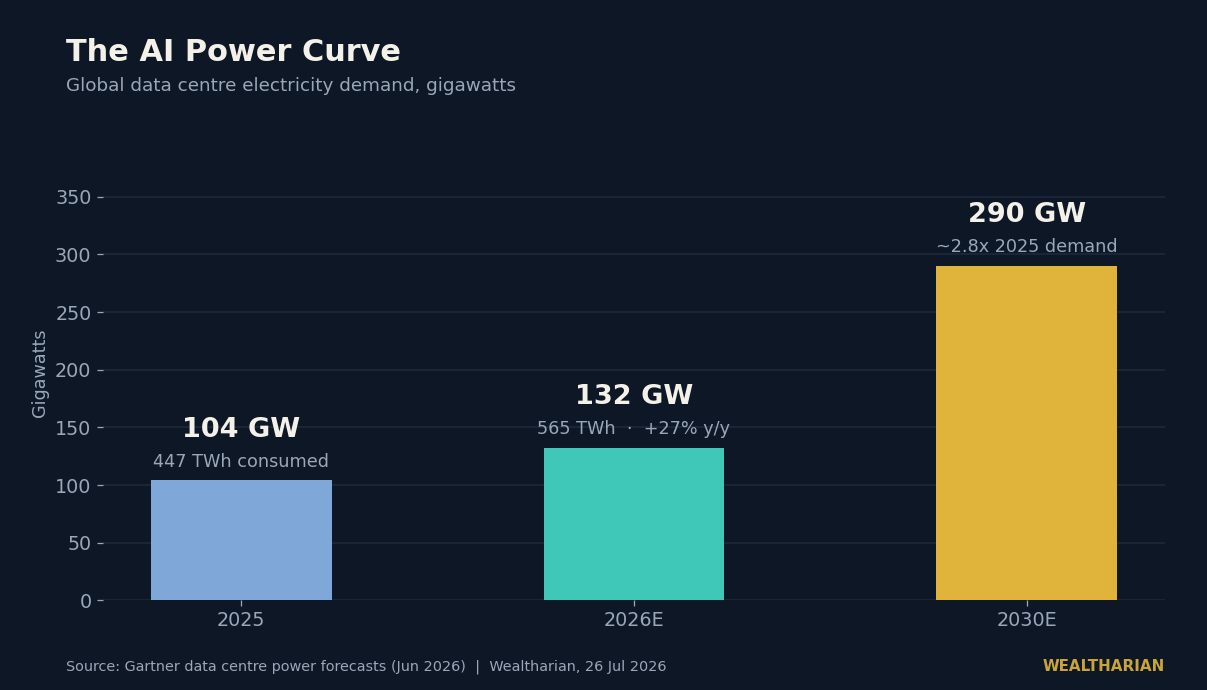
Global data centre power demand will hit roughly 132 GW this year, up from 104 GW in 2025. That’s a 27% jump in twelve months, taking data centre electricity consumption from 447 to 565 terawatt-hours, with Gartner forecasting about 290 GW by 2030 — nearly triple today’s draw. These are not abstract industrial statistics. In the United States, data centres now account for roughly 40% of all growth in electricity demand. Somebody has to generate that power, somebody has to build the grid to move it, and somebody has to pay for both. That is why AI electricity prices have quietly become one of the most consequential wealth stories of the year.
That somebody paying is increasingly you.
The number that reframes the AI trade
For three years the consensus story about AI and the economy has run in one direction: AI is disinflationary. It makes workers more productive, it substitutes for expensive labour, it drives the marginal cost of cognitive work toward zero. Eventually that story is probably right.
But “eventually” is doing enormous work in that sentence. Right now, in 2026, the AI economy is not delivering cheaper goods and services at scale. It is delivering the largest privately financed infrastructure buildout in modern history — and infrastructure buildouts are inflationary while they are being built. Concrete, copper, transformers, turbines, skilled electricians, high-voltage interconnects, and above all electricity: every one of those inputs is being bid for by companies with effectively unlimited balance sheets, against households and small businesses that have very limited ones.
That was never going to be a fair fight.
Who actually pays
Look at where the price pressure is concentrated and the pattern becomes impossible to miss.
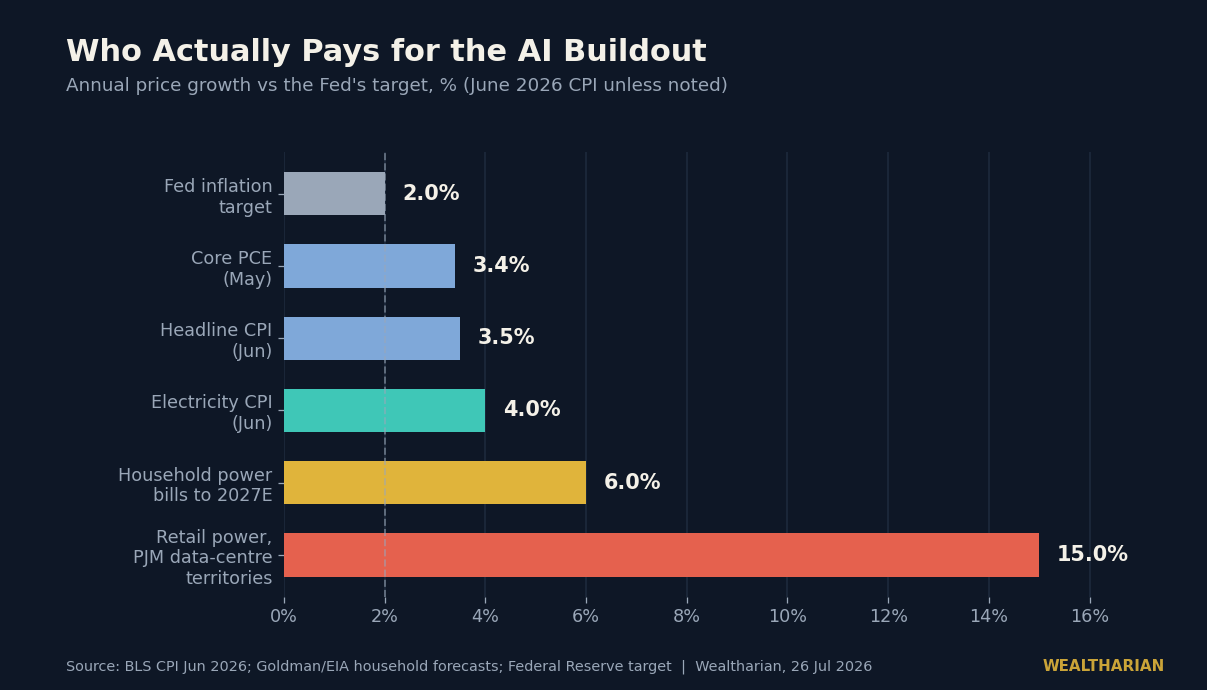
In regions with heavy data centre clustering, electricity prices have risen 267% over the past five years. In the PJM interconnection — the grid serving the mid-Atlantic and the world’s densest concentration of data centres — the capacity market has spiked nearly tenfold, and in some service territories that single line item has pushed retail electricity prices up more than 15%. Nationally, US households are forecast to absorb another 6% increase through 2027.
The official inflation data tells the same story more quietly. June’s CPI put electricity at +4.0% year over year — cooling from 5.9% in May, but still double the Fed’s 2% target. Core PCE sits at 3.4%, the 63rd consecutive month above target. Headline CPI is 3.5%.
Here is the part that should bother you regardless of what you own: this is a transfer, not a cost. The households paying more for power are not shareholders in the data centres driving the demand. They are financing, through their utility bills, an infrastructure asset base whose returns accrue entirely to someone else. Regulated utilities recover capacity costs from the whole ratepayer base. The AI company gets the compute. The retiree in Ohio gets the bill.
Call it what it is: an AI tax nobody voted for.
The feedback loop nobody is pricing
Now connect two things the market currently treats as separate.
Thing one: the AI buildout is pushing up energy prices, and energy prices feed directly into headline inflation and indirectly into almost everything else, because electricity is an input to nearly every good and service produced.
Thing two: the Federal Reserve meets on July 29. Chair Kevin Warsh has told Congress he has “no tolerance” for high inflation and intends to make it “a thing of the past.” The dot plot is split roughly down the middle on whether the next move is a hike. As we argued when the market stopped waiting for rate cuts, the era of assuming policy comes to the rescue is over.
Put those together and you get an uncomfortable loop. AI capex raises power prices. Power prices keep inflation sticky. Sticky inflation keeps the Fed hawkish. A hawkish Fed raises the discount rate. And a higher discount rate is the single most damaging input for exactly the kind of asset the AI trade is made of: long-duration equities whose value sits in cash flows a decade out.
The AI trade is, mechanically, short itself. The more aggressively the buildout proceeds, the tighter the monetary conditions under which it has to be financed. We saw the equity-market version of this in July, when chips lost $1.5 trillion while private AI marks kept climbing. The energy channel is the same story running through the macro plumbing instead of the tape.
The monetisation gap makes it worse
If AI were already throwing off the cash flows to justify the spending, none of this would matter much. You would simply be watching a fast, expensive, profitable buildout.
It is not there yet. Microsoft expects total 2026 capital expenditure of around $190 billion, with roughly $25 billion of the increase attributable to AI infrastructure. Against $97 billion spent over the trailing four quarters, its AI services generate about $37 billion in annual recurring revenue. That is real money and it is growing fast — but it is not yet a return that clears the cost of the asset base, and Microsoft is the best positioned player in the field. We walked through the broader arithmetic in the $700 billion capex bill.
So the sequence for the next 18 months looks like this: spending stays high, power prices stay elevated, monetisation improves but lags, and the Fed stays unfriendly. That is not a crash thesis. It is a grind thesis — and grinds are where undisciplined positions quietly die.
How to get on the right side of the meter
None of this is an argument against AI. AI is genuinely one of the most important wealth-building technologies of this decade, and the fact that building it out is expensive does not make it a bad idea — the interstate highway system was expensive too. But there is a large difference between believing in a technology and being positioned to profit from it.
- Own the constraint, not the story. The bottleneck in AI is no longer chips. It is power — generation, transmission, cooling, land near substations. Merchant generators with hyperscaler contracts have already been repriced for this: utility ETFs are up around 8% year to date, and XLU trades near 23x earnings against a 17x historical norm. That tells you the thesis is correct and partly priced. Buying a correct thesis at a bad price is still a bad trade.
- Watch the regulatory turn. Ratepayer backlash is the most under-modelled risk in the AI energy trade. When residential bills rise 15% because a hyperscaler moved in, state regulators eventually respond — with large-load tariffs, cost-allocation rules, or interconnection restrictions. That shifts economics away from incumbent utilities and toward whoever can build behind the meter.
- Treat your own energy line as an asset decision. Most people treat the power bill as weather. It is not. A fixed-rate supply contract before winter, insulation, and a heat pump are financial instruments in an environment where the underlying commodity is structurally bid. A locked-in rate that saves €400 a year is, at a 4% withdrawal rate, the equivalent of owning an extra €10,000 of portfolio.
- Keep your earning power aligned with the buildout. Demand for electricians, HVAC engineers, grid technicians and power-systems specialists is going vertical for structural reasons that have nothing to do with the AI hype cycle. That is a wage story with years to run, available to people who never buy a share of anything.
The honest version
There is a moral dimension here worth stating plainly, because the wealth angle and the human angle point in the same direction.
Building enormous computing capacity is not inherently extractive. If it produces drug discovery, better diagnostics, cheaper engineering and genuine productivity, the world gets richer and the electricity was a bargain. That is value creation, and it is worth paying for.
But the distribution of who pays and who profits during the buildout is a policy choice, not a law of physics. Right now the costs are socialised across ratepayers and the gains are concentrated among shareholders. You can hold both thoughts at once: the technology is good, and the current arrangement for financing it is unfair. The realistic response, for anyone who is not a regulator, is to stop being purely on the paying side of that arrangement.
The AI boom will make a lot of money for a lot of people. Make sure at least some of it flows to you, rather than out of you at 4% a year.
Want to track your own path to financial independence? The Wealtharian Wealth Tracker lets you monitor your net worth, FU money progress, and investment milestones in one place. Try it free →