
Last night Alphabet reported one of the best quarters in its history — revenue up 24% to $119.8 billion, Google Cloud up 82%, operating income up 30% — and the stock fell 5%. The reason wasn’t the results. It was a single line of guidance: AI capex is going to $205 billion. If you want to understand where wealth will be created and destroyed over the next five years, that one number is the place to start.
The quarter was great. The bill was the story.
Alphabet’s Q2 checked every box investors say they want: accelerating revenue, an 82% surge in cloud (driven almost entirely by AI demand), and operating income growing faster than revenue at +30%. Then management raised full-year 2026 capital expenditure guidance from $180–190 billion to $195–205 billion — quarterly capex alone hit $44.9 billion, roughly double a year ago — and warned spending rises again in 2027. The market’s response: sell first, ask questions later.
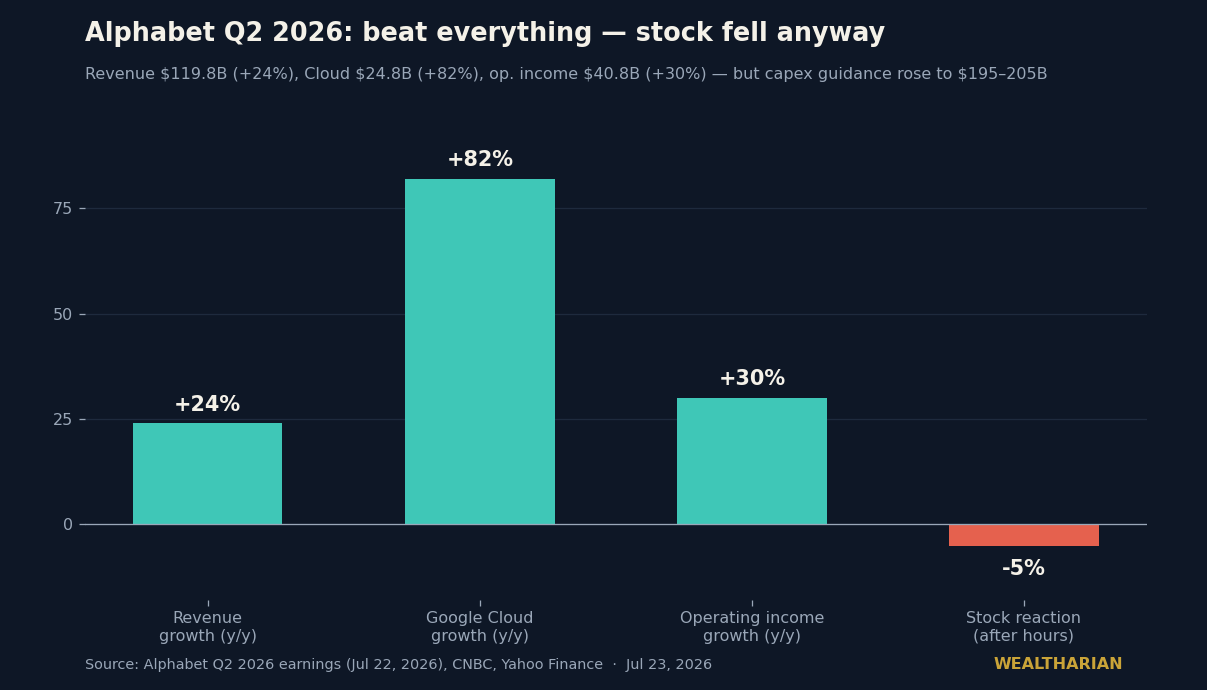
Here’s what that reaction actually tells you: Wall Street has stopped debating whether AI demand is real — an 82% cloud growth number ends that argument, a shift we covered when the AI trade split in two earlier this month — and started debating whether the return on this spending will ever justify it. That’s a different, and much more interesting, question for your money.
The ~$700 billion AI capex buildout, in context
Alphabet isn’t alone. Add up the 2026 plans: Amazon around $200 billion, Microsoft an estimated $150 billion, Meta in the $115–135 billion range, Oracle roughly $50 billion. Combined, the big five are committing close to $700 billion of capital expenditure in a single year — nearly double 2025 levels, with roughly three-quarters of it going directly to AI infrastructure.
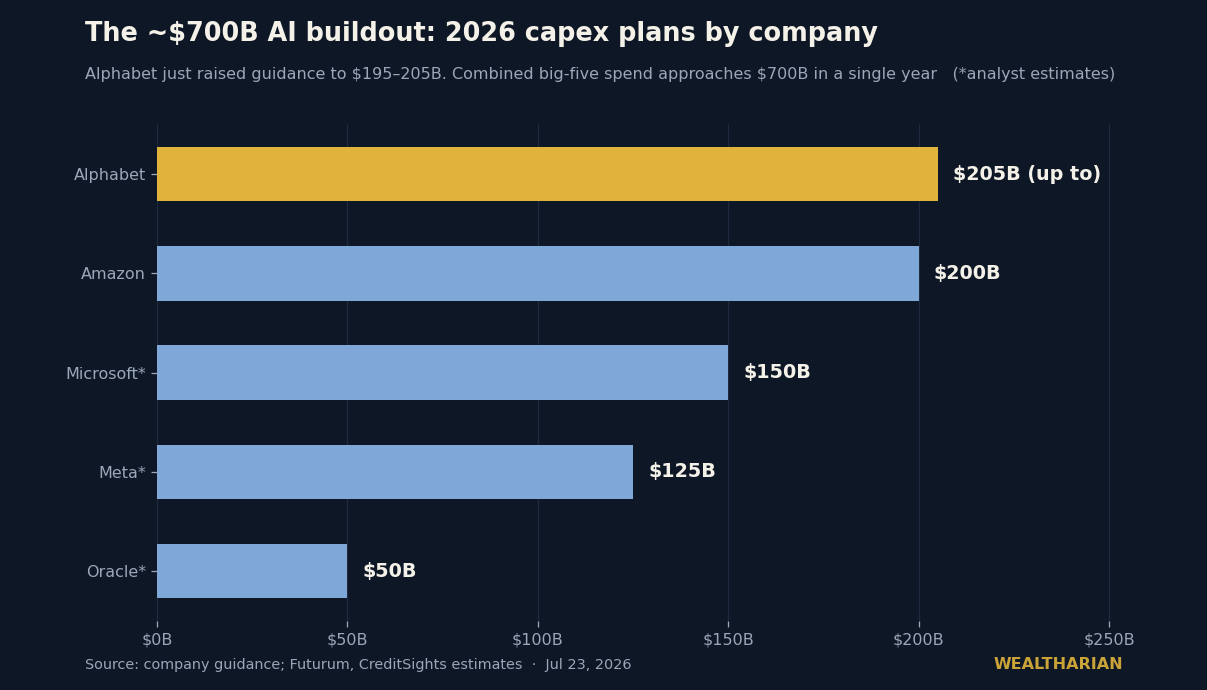
For scale: that’s more than the entire inflation-adjusted cost of the Apollo program — spent not over a decade, but in one year, by five companies, with cash they mostly generate themselves. This is the largest private infrastructure buildout in history, and it’s being priced by the market as if it were a spending problem.
Follow the checks, not the narrative
Every one of those ~$700 billion has a recipient. When you stop asking “is Google spending too much?” and start asking “who is Google paying?”, the wealth map redraws itself:
Compute and memory. The obvious layer — GPUs, custom accelerators, and the high-bandwidth memory that only a handful of companies on Earth can manufacture. Scarcity plus surging demand is the oldest wealth formula there is.
Power. Data centers run on electricity, and the grid wasn’t built for this. Utilities, natural gas, nuclear and uranium names have quietly become AI infrastructure plays. The most boring stocks in your portfolio may now be AI stocks.
The physical layer. Cooling systems, transformers, switchgear, construction, industrial land near power and fiber. Unsexy, capacity-constrained, and directly in the path of the money.
Second-order effects. Electricity prices, data-center REITs, and the countries and regions that host the buildout. Infrastructure spending at this scale doesn’t stay inside tech — it leaks into the real economy.
The dot-com lesson everyone quotes and nobody applies
Here’s the contrarian part. The bears say this looks like the fiber-optic bubble of 1999 — hundreds of billions spent on capacity ahead of demand. They’re half right, and the half they’re right about matters: the internet was real, and Global Crossing still went to zero. A technology succeeding and your specific stock making you money are two different events. In every buildout, the spenders’ shareholders take the ROI risk, while the suppliers get paid regardless of whose model wins.
But the half they’re wrong about matters more. The fiber bubble was funded with debt by companies with no earnings, building ahead of demand. This buildout is funded largely from operating cash flow by the most profitable companies in history, while demand visibly outruns supply — again: cloud grew 82% with capacity constraints. That doesn’t mean every AI stock is cheap. It means the “it’s all a bubble” and “it can’t fail” crowds are both skipping the actual work: which layer are you buying, who has pricing power, and what happens to that business if the buildout slows by half?
How to position without betting the house
The practical playbook is neither all-in nor abstinence:
Own the toll collectors as the core. Businesses that get paid whichever AI lab or cloud wins — compute, memory, power, physical infrastructure — carry less narrative risk than picking the winning model.
Size the story stocks like stories. Yesterday’s action was the reminder: a single guidance line moved Alphabet 5% and Tesla dropped 12% on one call. If one earnings print can change your net worth by double digits, that’s a position-sizing problem, not a market problem. Panic-selling into moves like these is exactly the market-timing trap July 2026 keeps teaching.
Keep a base that doesn’t care. Gold near record highs — it just passed 2026’s inflation-hedge test — and the 10-year near multi-year highs mean the macro backdrop is loud. Your foundation (cash runway, diversified index core, income engine) is what lets you hold the AI positions through the drawdowns that will absolutely come.
The market just told you it’s scared of the biggest infrastructure buildout in history. Scared markets misprice things. That’s not a reason to be reckless — it’s a reason to be deliberate.
Want to track your own path to financial independence? The Wealtharian Wealth Tracker lets you monitor your net worth, FU money progress, and investment milestones in one place. Try it free →