
For two years the entire market has been positioned for one story: rate cuts are coming, so buy risk. This week that story died — markets now price a 72% chance of a Fed rate hike in 2026, and almost nobody’s portfolio is built for it. Oil is above $100, inflation is running at double the Fed’s target, and the 10-year Treasury just hit its highest level since January 2025. If your wealth plan was waiting for rate cuts, it’s time for a new plan.
How a hike went from joke to base case
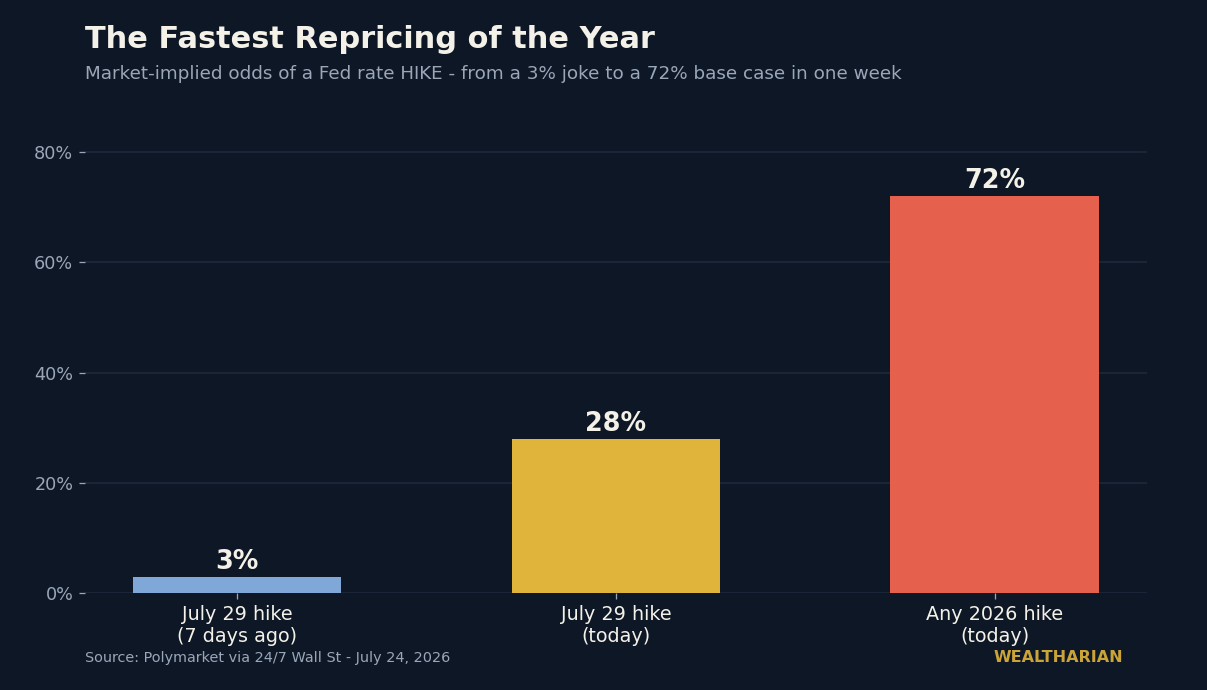
Seven days ago, the odds of a hike at the July 29 FOMC meeting sat at 3%. Today they’re 28%, with full-year 2026 hike odds at 72% on prediction markets. That is one of the fastest macro repricings since the war premium first hit oil.
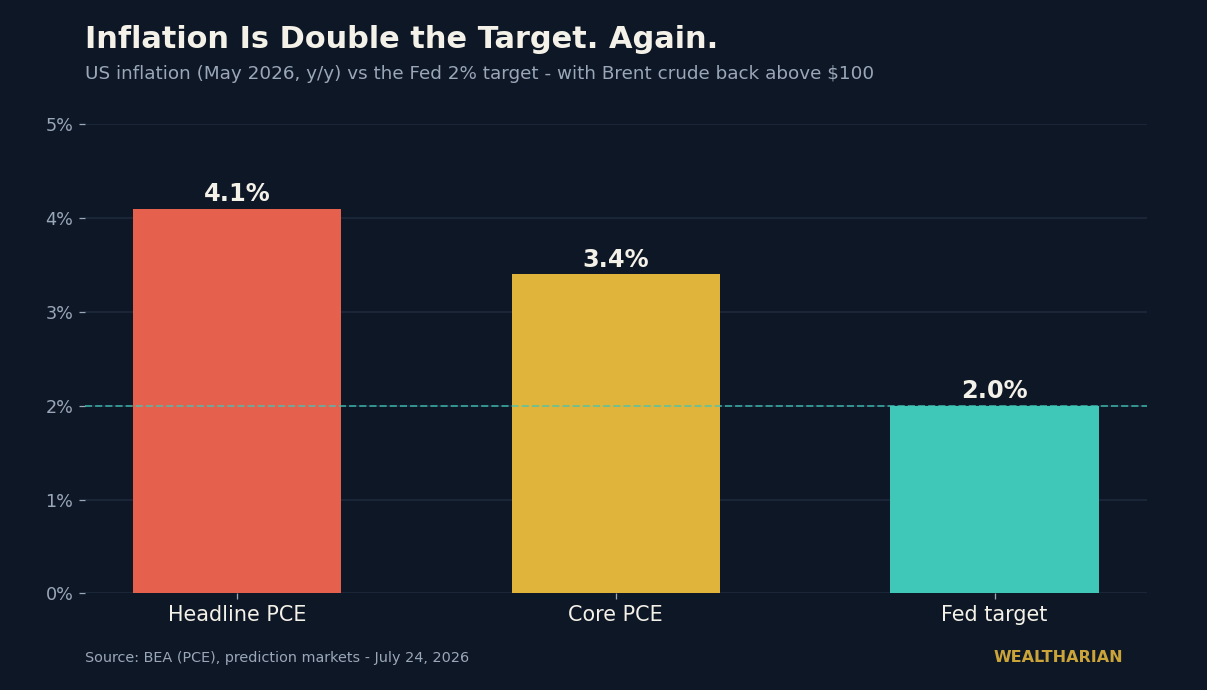
The trigger stack is brutal: Houthi attacks on two Saudi tankers pushed Brent crude past $100 for the first time since May. Headline PCE inflation is running 4.1% year over year — up from 3.8% — with core at 3.4%. The labor market has firmed instead of cracking. And the 10-year Treasury yield climbed to 4.71%, rising four straight sessions as bond investors stopped pretending the next move is down.
Fed Chair Kevin Warsh told Congress the latest improvement isn’t “mission accomplished.” Translation: the committee that spent 2025 hinting at cuts is now openly keeping a hike on the table. June’s CPI did fall 0.4% on the month — a rare dovish data point — but one soft print against $100 oil is a hope, not a trend. We walked through the mechanics of a hiking Fed in The Fed Just Flipped: What a 2026 Rate Hike Means for Your Wealth — what’s new this week is that the market finally agrees.
Rate cuts were never a wealth plan
Here’s the uncomfortable part. If the last two years of your investment strategy could be summarized as “hold on until the Fed cuts,” you never had a strategy — you had a bet on a committee of twelve people in Washington doing what you needed them to do, on your schedule.
The wealthy don’t build portfolios that require a specific Fed decision to work. They build portfolios that get paid in every regime — and right now, the high-rate regime is quietly one of the most generous to capital in decades:
Cash finally pays. Short-term Treasuries and money market funds yield more than 4% risk-free. For the first time in years, the boring part of your portfolio is an income engine instead of dead weight.
Debt paydown is a guaranteed return. Every dollar of 8% credit-card or floating-rate debt you retire is an 8% after-tax, zero-risk return. In a week where the S&P fell 1.2% in a day, guaranteed 8% is not a consolation prize — it’s the best risk-adjusted trade most households can make.
Hard assets are confirming the story. Gold at roughly $4,044 an ounce — within sight of its record — isn’t an accident. It’s what it looks like when the world hedges inflation that won’t die and deficits that won’t shrink. We tested that thesis in The Great Inflation Hedge Test of 2026: Gold Passed, Bitcoin Failed.
High rates are a wealth transfer from people who owe capital to people who own it. The only question is which side of that transfer you’re standing on.
What a hike actually punishes: duration
Look at what happened this week. Alphabet grew revenue 24%, grew Cloud 82%, beat on operating income — and fell 7%. Tesla dropped 14% on a single earnings call. The S&P lost 1.2%, the Nasdaq 2.2%.
The headlines called it an earnings story. It’s mostly a rates story. When the 10-year yields 4.71%, every asset whose value lives in 2030 earnings gets marked down today — that’s just math. Growth stocks priced for perfection, unprofitable moonshots, long-duration bonds, speculative crypto: they all share one gene, and rising rates attack exactly that gene.
This is why “diversification” that’s actually five different flavors of long-duration tech isn’t diversification. If one FOMC meeting can move your net worth by double digits, you don’t have a portfolio — you have a position.
The high-rate playbook
1. Get paid while you wait. Park real allocation in T-bills or money market funds at 4%+. This is your optionality: income today, dry powder for the drawdowns a hiking cycle tends to produce.
2. Kill expensive debt first. Nothing in public markets reliably beats retiring double-digit-rate debt. It’s the one guaranteed return in finance.
3. Own some of what inflation feeds. Energy producers get paid directly by $100 oil. Gold hedges the regime. These aren’t trades so much as insurance that happens to pay premiums.
4. Keep buying productive assets — deliberately. The investors who bought quality assets through 1981’s double-digit rates caught the greatest bull market in history. The ones who bought through 2022’s hikes caught the AI rally. High-rate periods feel terrible and price beautifully. Keep the automatic buying on; just size the long-duration bets like the bets they are. Our full framework is in the Higher-for-Longer Wealth-Building Playbook.
5. Don’t flip to all-cash either. June CPI fell 0.4% in a month. If the Middle East de-escalates and oil retraces, the hike evaporates and risk assets rip. Position for both futures — income now, ownership for later — because the honest answer is nobody knows, including the Fed.
The bottom line
The market spent two years waiting for permission from the Fed to get rich. Permission isn’t coming — and that’s fine, because it was never required. Rates at these levels pay you to hold cash, reward you for killing debt, and hand you better prices on the assets everyone else is too scared to buy. Scared markets misprice things. Deliberate people get paid for noticing.
Want to track your own path to financial independence? The Wealtharian Wealth Tracker lets you monitor your net worth, FU money progress, and investment milestones in one place. Try it free →