
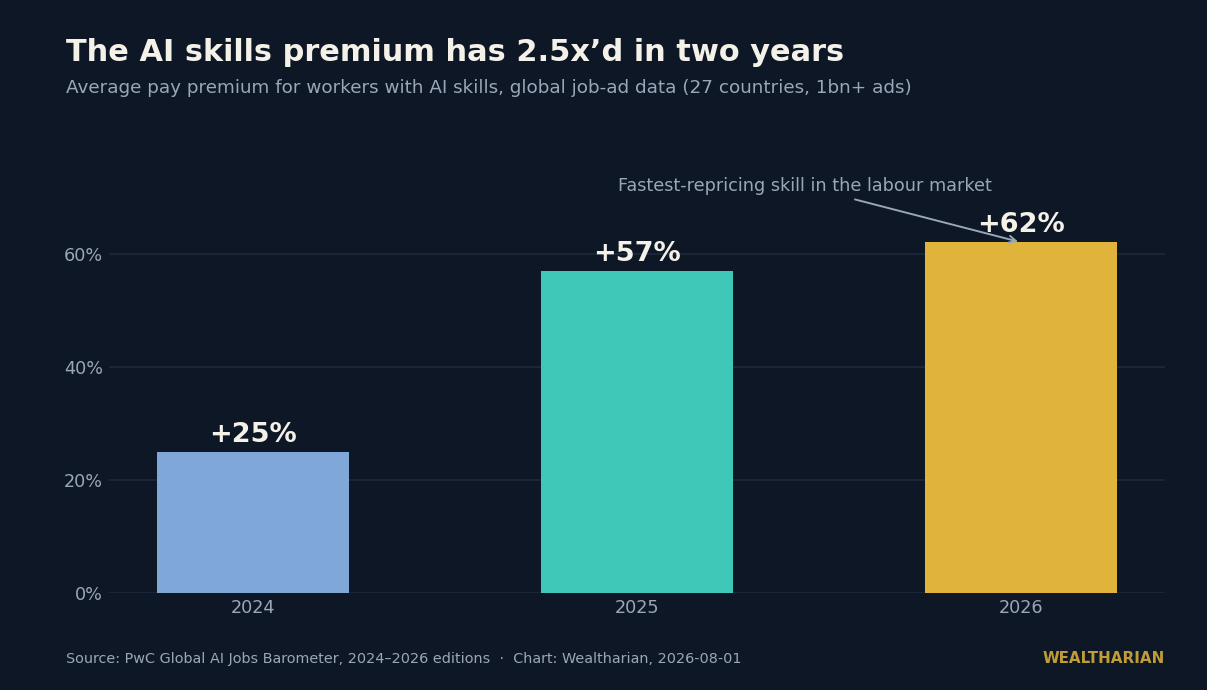
Two numbers came out of the same research this year, and almost nobody put them side by side. Workers with AI skills now earn a 62% wage premium — up from 57% last year and 25% in 2024. And entry-level roles in the occupations most exposed to AI are now seven times more likely to demand skills that used to belong to senior people. The AI skills wage premium is the largest, fastest-repricing pay gap in the labour market. The problem is that the staircase you used to climb to reach it has had its bottom three steps removed.
First, kill the story you have been told
The dominant narrative is that AI is quietly deleting jobs, starting with the young. The hiring data does not support it. US employers project a 5.6% increase in hiring for the Class of 2026 over the prior year. IBM says it will triple US entry-level hiring this year. In ZipRecruiter’s 2026 employer survey, 2.7 times as many senior talent leaders expect AI to increase entry-level hiring as expect it to fall.
Meanwhile, 62% of workers believe companies are cutting entry-level roles because of AI — but only 31% say it has actually happened in their own field. That is a two-to-one gap between the fear and the experience, and it is doing real damage: people are making twenty-year career decisions based on a headline the data does not back.
So the jobs apocalypse has not arrived. Something more interesting, and in some ways more expensive, has.
The contrarian read: AI did not take the job, it took the apprenticeship
PwC’s 2026 Global AI Jobs Barometer — built on more than a billion job advertisements across 27 countries — gave the phenomenon a name: seniorisation. Since 2019, job openings that carry an entry-level title but demand senior-level capabilities have grown 35%. Traditional entry-level openings — the ones where you were paid an ordinary wage to be slow and learn — have fallen 10%.
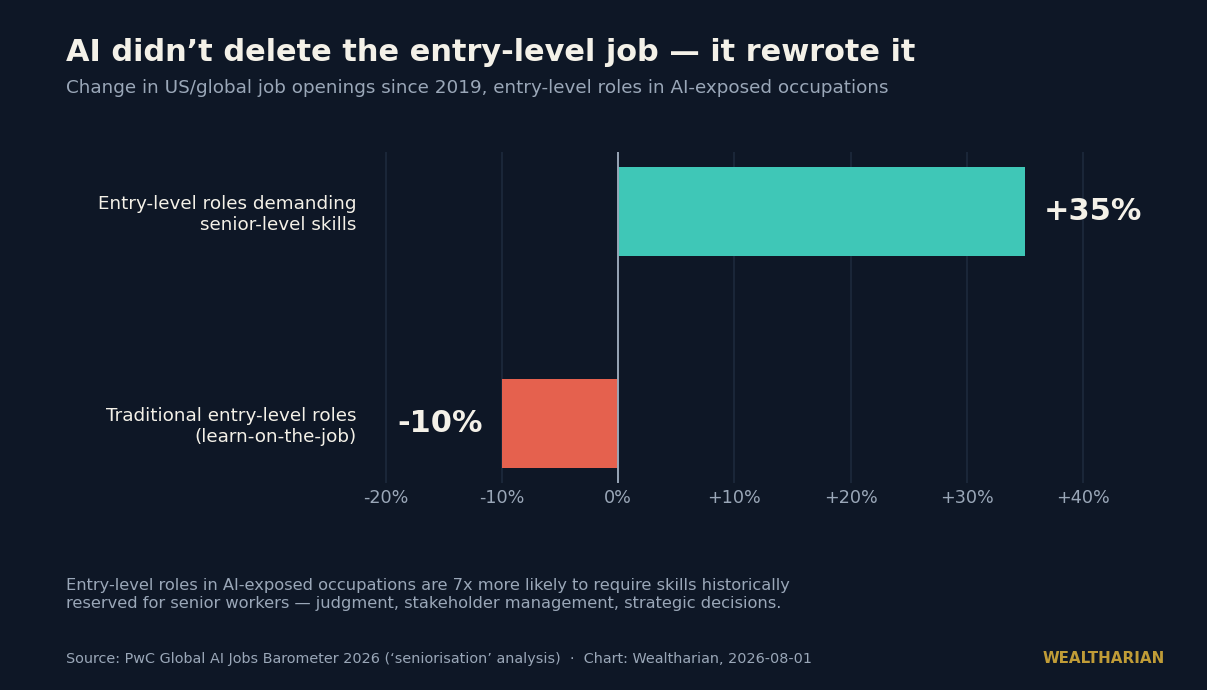
Read that as an accounting entry rather than a labour statistic and it becomes obvious. The junior tasks — the first draft, the reconciliation, the deck, the research memo, the boilerplate contract — were never how a company made money from a 23-year-old. They were the company’s tuition payment. You produced something of modest value while a senior person corrected you, and over three years that correction turned you into someone worth paying properly.
AI now does the first draft. The tuition line item has been optimised away. What remains in the job description is the part that was always hard to automate and always hard to teach: judgement, stakeholder management, knowing which question to ask. Employers now want that on day one — 31% of them say AI has explicitly raised the experience bar for entry-level roles.
Nobody decided this. It is the same instinct we have watched Big Tech apply to its own balance sheet, where the depreciation line quietly rewrites the earnings — a cost that used to be invisible becomes visible, and once it is visible somebody cuts it. Corporate training was invisible. Now it is a line.
What the AI skills wage premium is actually worth
Most people hear “62% wage premium” as a nice raise. It is not a raise. It is a change in the slope of your entire earnings curve, and slope compounds.
Take an illustrative $70,000 salary. A 62% premium is roughly $43,400 a year. If you never spent a dollar of it and invested the difference at 8% annually, it becomes about $629,000 over ten years and roughly $1.99 million over twenty. That is not a career decision. That is the difference between working until 67 and being done at 50.
And the demand side is moving even faster than the price. Jobs requiring specific AI skills are growing at 69% against 9% for the overall job market — nearly eight times the rate. The premium is not uniform: it runs as high as 118% in consumer markets and as low as 16% in government and public-sector work. Where you apply the skill matters as much as having it.
Here is the uncomfortable part. Premiums this large are, by definition, temporary. They exist because supply has not caught up. The 25% → 57% → 62% path is already decelerating in the last step. This is an arbitrage with a closing window, which is exactly how you should treat it — the same way you would treat any mispricing you were lucky enough to notice early.
Four moves, not four tips
1. Stop waiting to be trained. The employer-funded apprenticeship is gone as a default. If you are early in your career, you are now responsible for capitalising your own human capital — and you should think of it as capex, with a return you can estimate, not as self-improvement.
2. Buy the scarce half, not the popular half. Everyone is learning to prompt. The seniorised job descriptions are asking for something else: strategic decision-making, stakeholder management, leadership under ambiguity. AI fluency plus judgement is the combination being paid 62%. AI fluency alone is table stakes within eighteen months.
3. Choose the industry deliberately. A 118% premium and a 16% premium are the same skill in different rooms. If you are optimising for wealth rather than mission, the room is most of the decision.
4. Convert the premium, do not absorb it. A higher salary fully consumed by a higher standard of living is a treadmill with better upholstery. The whole point of an income premium is that it becomes owned assets. Most people who earn more simply spend more — which is why record savings rates can coexist with falling balances. Route the difference before you ever see it.
The bottom line
The debate about whether AI destroys jobs is the wrong debate, and it is absorbing attention that should be going somewhere far more actionable. The count of jobs is broadly fine. What changed is the price of the first rung — the market removed the subsidised years in which you used to become valuable, and replaced them with a demand that you arrive valuable.
That is a harder world for anyone waiting to be developed, and a spectacular one for anyone willing to develop themselves on their own clock. The 62% is sitting there. It is being paid, right now, to people who did not wait for permission. And like every mispricing — including the one currently playing out in how the market rewards AI spending — it will be arbitraged away by the people who move first.
Which rung are you standing on, and who do you think is paying for the next one?
Want to track your own path to financial independence? The Wealtharian Wealth Tracker lets you monitor your net worth, FU money progress, and investment milestones in one place.
Try it free →